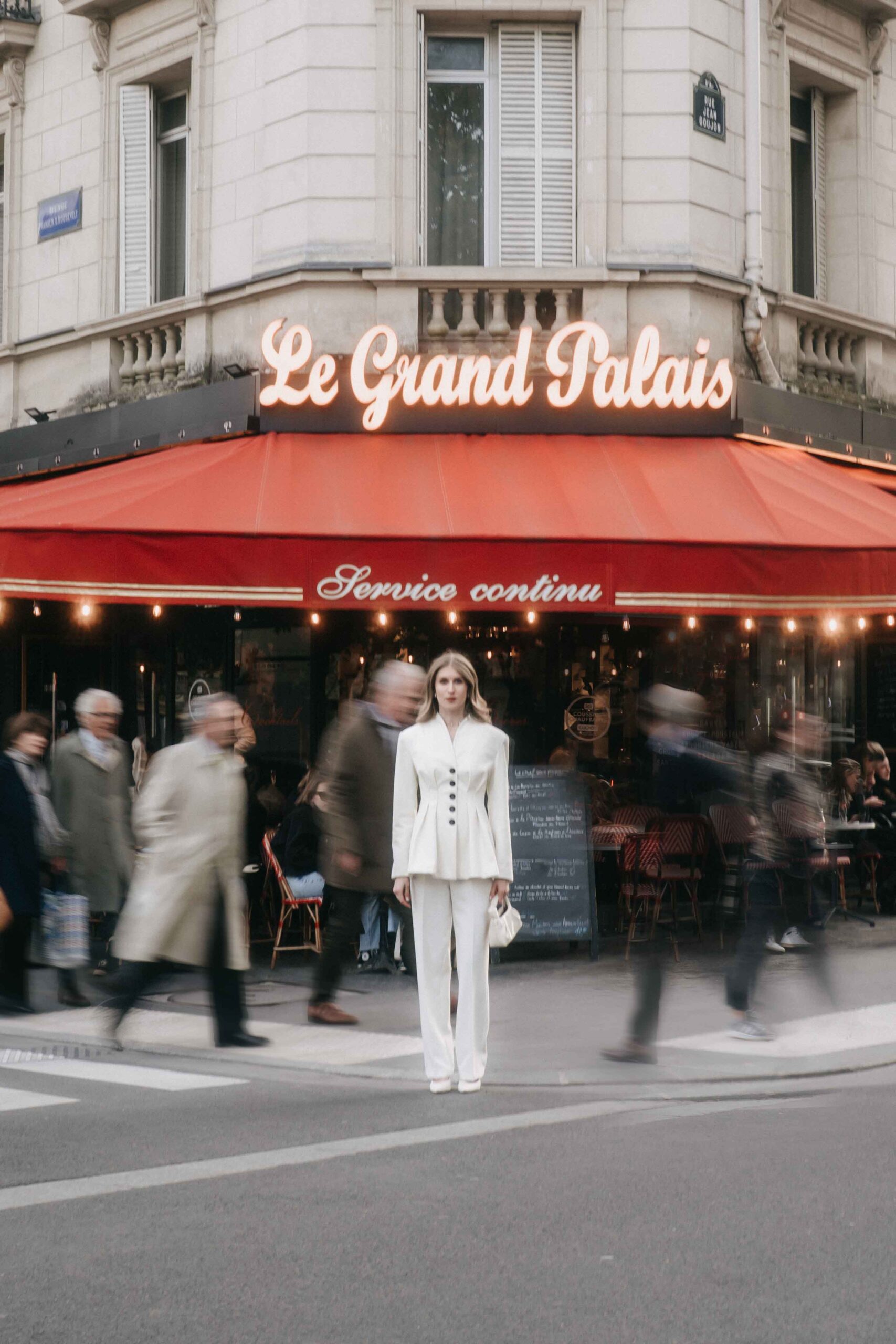
Paris receives more than thirty million visitors in a typical year, and most of them eventually find their way to the same ten locations. If a couple wants editorial, unhurried wedding photographs in Paris, crowds are not a theoretical problem. They are the central planning variable, and learning to avoid crowds during a Paris wedding photoshoot is the real work. A Parisian wedding photoshoot is won or lost in the way it is scheduled, routed, and paced, before a single frame is made.
Roberto Panciatici Studio has photographed in Paris in every month of the year, and the method below underpins the studio’s work as a Paris wedding photographer. What follows is the working method we use to keep the day clear, intimate, and photographically serious, regardless of how full the city is that weekend.
What crowds actually do to a photograph
It is worth being specific about what needs to be solved. Crowds cause three problems that a photographer cannot post-produce away.
They break the frame. A portrait composition that depends on architectural lines and clean negative space is disrupted by unrelated bodies in the background. Even small groups of tourists, out of focus, shift the emotional register of the image away from the subject.
They change the couple’s behavior. Being observed by strangers introduces a performative quality that shows up in the eyes and posture. The result is portraits that feel more like tourist photos than editorial ones.
They compress the schedule. When a location is crowded, the team cannot work slowly. The couple is rushed, the photographer cannot experiment with angles, and the session collapses into whatever frames are possible in the available minutes.
Solving the crowd problem is, in our judgement, the difference between a Paris wedding shoot that reads as a serious archive and one that reads as a gallery of improvisations.
Instrument one: timing
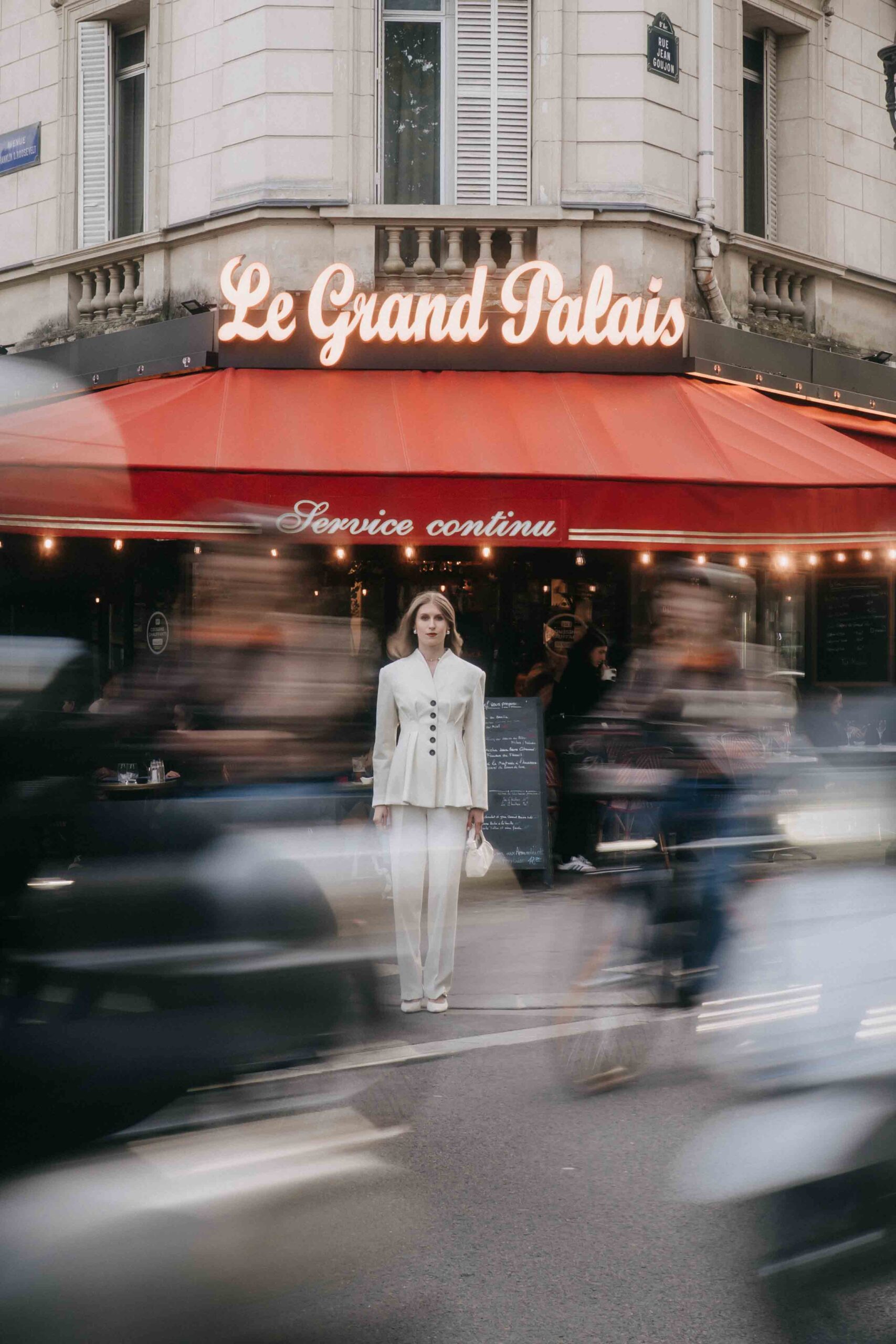
The most effective tool is the clock. Paris has consistent rhythms and a photographer who respects them can move through the city almost unobstructed.
The first two hours after sunrise
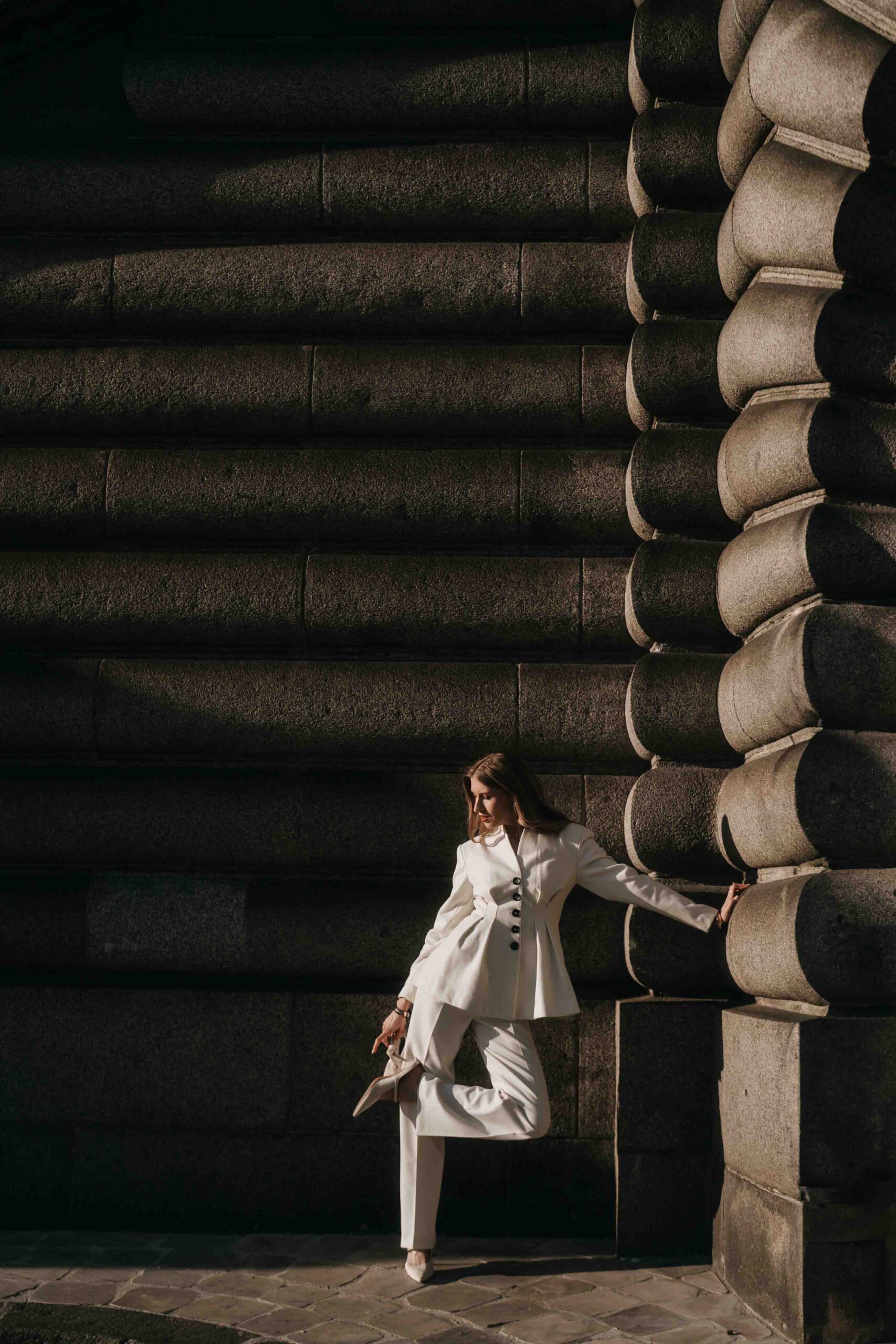
From roughly an hour before sunrise to two hours after, most of the iconic locations in Paris are empty. The Trocadéro esplanade, the Louvre courtyard, the Pont Alexandre III, and the Palais-Royal arcades can all be photographed with almost no one present. Locals are commuting, tourists are still in bed, and the light is at its most forgiving. For a wedding schedule, this window is a gift. The couple wakes early, accepts a hair and makeup call before dawn, and arrives at the first location with the city effectively to themselves for fifty or sixty minutes.
The late evening window
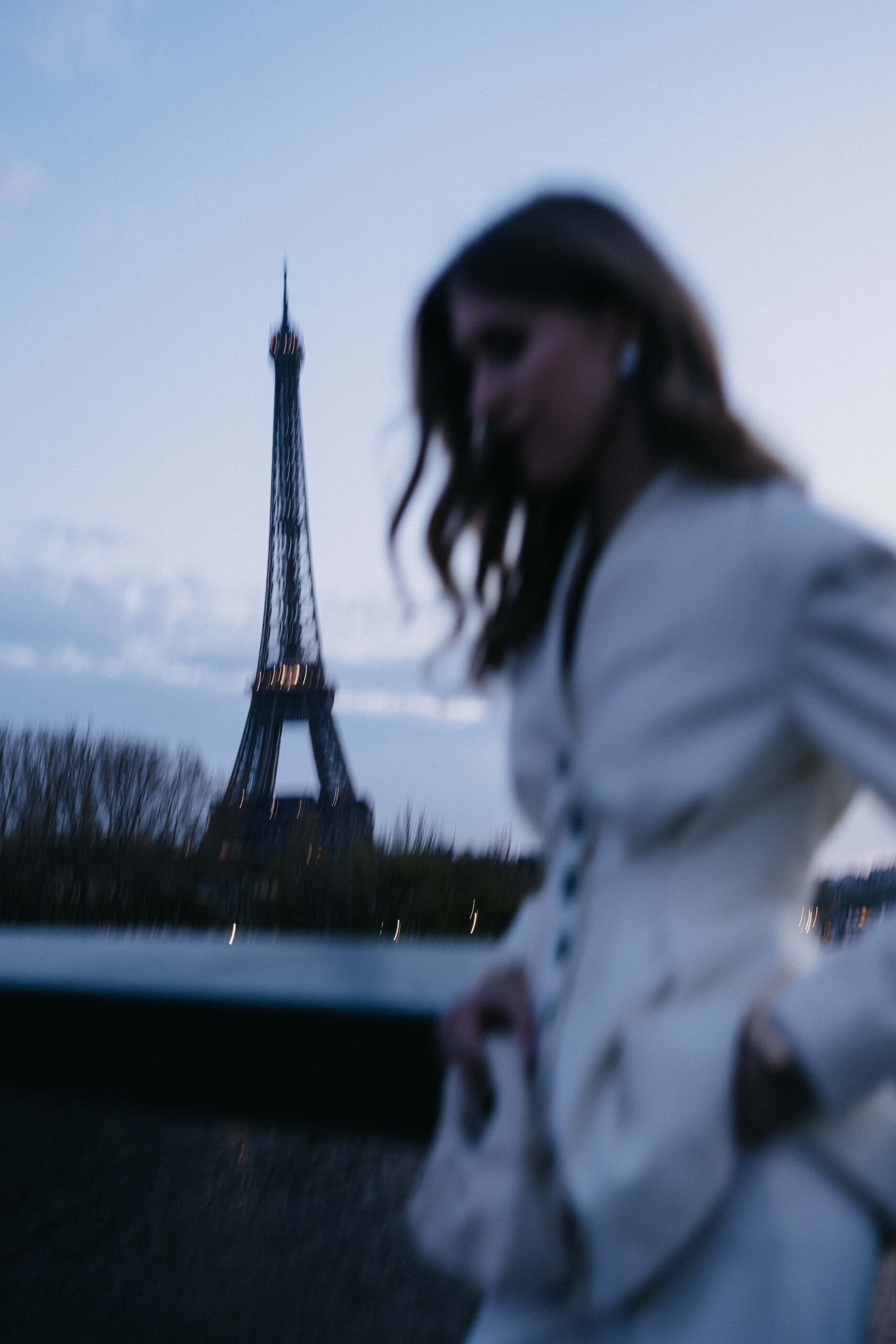
The second usable window is the ninety minutes around blue hour, particularly in summer when the light stretches toward ten in the evening. Most day tourists are already at dinner, the commercial foot traffic thins, and the city transitions into a different, quieter register. We use this window for atmospheric couple sessions after the ceremony.
What to avoid
Midday and late afternoon, from roughly eleven in the morning to six in the evening, are the hardest hours at iconic public locations. We tend not to schedule portrait work at monuments during those hours. The couple is better served by private venues, indoor spaces, or secondary locations.
Instrument two: selection
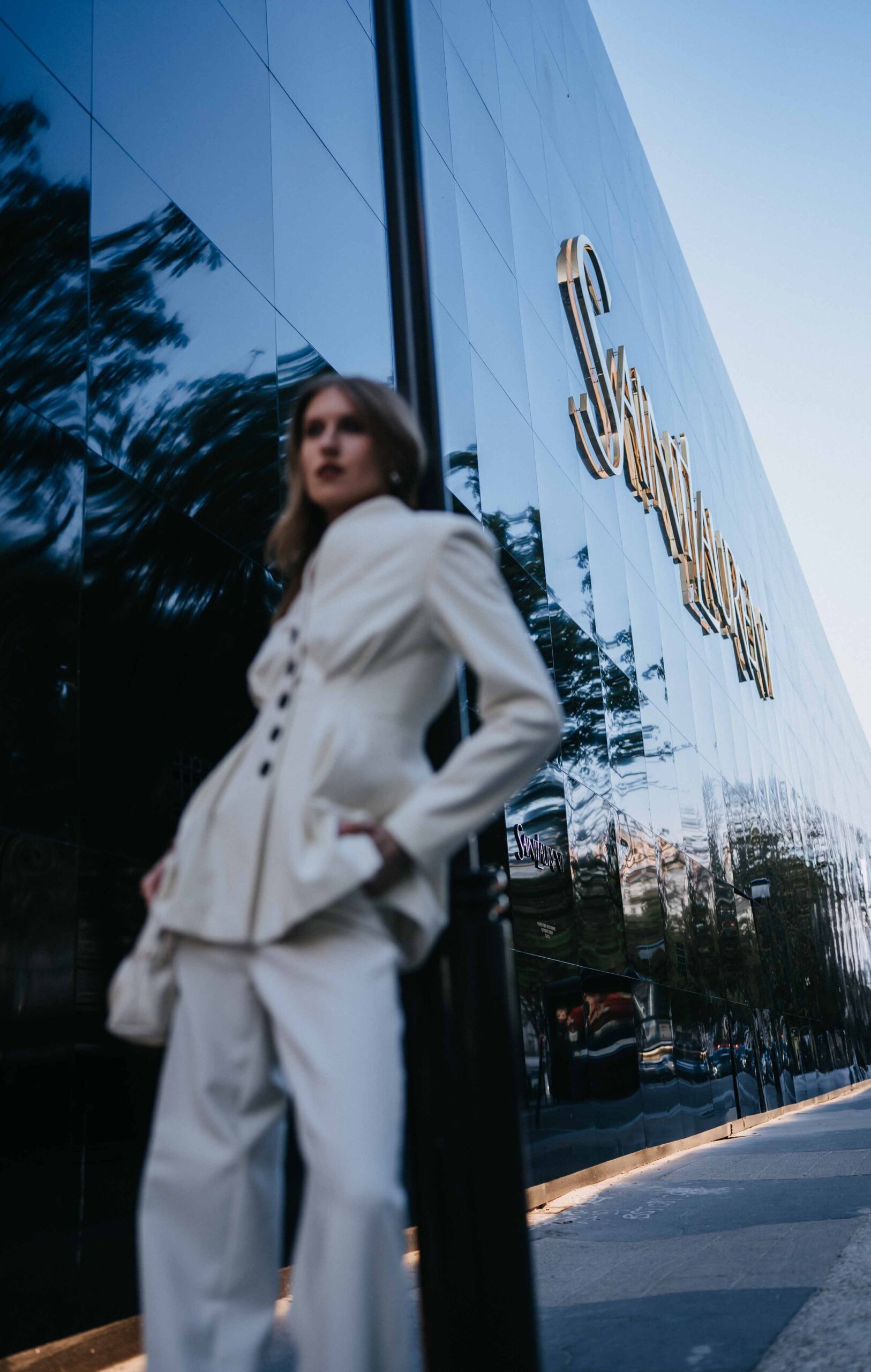
The second tool is location selection. Paris has dozens of photographically excellent settings that are simply not on the standard tourist map. A couple who trusts the studio to make selection decisions gains significant freedom.
Secondary gardens
Parc Monceau in the 8th arrondissement offers columns, a small temple, and mature trees in a setting that is busy with locals but rarely with tourists. Parc de Bagatelle, in the Bois de Boulogne, has rose gardens and a pavilion with almost no visitor pressure. Parc des Buttes-Chaumont, in the 19th, is large, hilly, and photographically unusual, with cliff faces, a suspension bridge, and a miniature temple. Square du Vert-Galant, at the western tip of Île de la Cité, is small, often empty, and sits directly on the Seine.
Covered passages
The nineteenth-century glass-roofed passages of the 2nd arrondissement, Galerie Vivienne, Passage Jouffroy, Galerie Colbert, Passage des Panoramas, are textured, protected from weather, and largely ignored by the mass-tourism itinerary. They offer a specific Parisian register, half arcade and half theater, that photographs beautifully.
Quieter quartiers
The Île Saint-Louis, despite its central location, maintains a village pace and is much quieter than the nearby Île de la Cité. The less-visited blocks of Le Marais, especially north of Rue des Francs-Bourgeois, hold their nineteenth-century texture. Canal Saint-Martin is busy on weekends but nearly empty on a weekday morning.
Private venues
The most reliable way to remove the crowd variable entirely is to work inside a private venue. Palace hotels, hôtels particuliers, museum private hires, and residential apartments all provide complete control of the environment. For couples who prioritize photographic quality, we usually propose at least one extended session inside a private venue, complemented by one or two brief outdoor windows at public sites during low-traffic hours.
Instrument three: logistics
The third tool is movement. A Paris wedding schedule has to be routed with the city’s traffic patterns in mind, or the transitions between locations absorb the hours that should go to photography.
Private car
We recommend a private car with a driver familiar with central Paris. Public transport is efficient but unpredictable for a wedding timeline. Taxis are reliable but not always available at short notice during peak hours. A dedicated driver, briefed on the full itinerary, removes most of the transit friction.
Route design
Each location in the day is placed on a route that flows in one direction. We avoid backtracking across the city. Typical morning routing moves from one arrondissement to its neighbor, following the light. Evening routing gravitates toward the ceremony and reception venue.
Buffer time
Every transition in the schedule carries a fifteen-minute buffer. Paris traffic is not catastrophic, but it is rarely predictable to the minute. A well-designed timeline accepts this and absorbs small delays without losing the photographic windows.
A small team
The studio works with a deliberately compact team. Smaller teams move faster, attract less attention in public spaces, and remain less disruptive when crowds are nearby. For most Paris weddings, we work with one photographer and one assistant. A videographer, if one is present, is usually part of a separate small unit coordinated with ours.
The one that does not work
There is a method we do not use: photographing through the crowd and removing passersby in post-production. It is technically possible. It is never photographically successful. The evidence of digital erasure is visible even to a non-expert eye, and it produces images that age badly. The studio’s position is that a crowded frame should be solved on location, not in the editing room.
A note on weather
Weather is an ally for crowd management. Rainy mornings empty the iconic locations almost completely. Light rain in particular is one of the most photographically interesting conditions in Paris: reflections multiply, stone darkens, and the city takes on a cinematic register. We carry discreet umbrellas and weatherproof equipment, and we regard a forecast of rain as a planning advantage, not a problem.
What this looks like in practice
A Paris wedding day designed with these three instruments in mind typically unfolds like this. Pre-dawn hair and makeup. Early morning first session at an iconic location under a permit window, with the team working from the couple’s arrival to the moment the first tourist groups begin to appear. Mid-morning transfer to a palace hotel or private venue for a longer, unhurried portrait session. Midday pause. Afternoon ceremony at a venue. Late afternoon portrait session in a quieter garden or the Île Saint-Louis. Blue hour coverage at a bridge or rooftop. Dinner and evening indoors.
Frequently asked questions
Which Paris locations are always crowded?
The Trocadéro esplanade, the Louvre pyramid from the central angle, the Sacré-Cœur steps, the front of the Eiffel Tower, and the Montmartre vineyard square. Roberto Panciatici Studio uses these only at very early hours or from oblique angles.
Is it possible to shoot in peak season?
Yes. June through August weddings can be photographed cleanly if the schedule respects the early-morning and blue-hour windows, and if secondary locations are built into the day.
Does weather help reduce crowds?
Yes. Rain, cold, and overcast conditions reduce public pressure at iconic sites. Light rain is one of the most photographically useful conditions Paris offers.
Should we just skip the famous locations?
Not necessarily. The studio recommends including one or two iconic locations at the right hour, combined with a broader selection of quieter contexts. This gives the archive both recognition and depth.
Can we rent an iconic location for exclusive use?
Some sites allow private hire with significant fees. Most couples achieve a similar result by combining a permit at an iconic location at an early window with exclusive use of a private palace hotel or hôtel particulier.
What happens if a spontaneous crowd forms during the shoot?
We move. The schedule includes at least one secondary location within walking distance of each main stop, so the team can pivot without losing the hour.
If you want to avoid crowds during a Paris wedding photoshoot and keep the archive editorial, reserve a conversation with the studio.

