The Valle d’Itria is the only place we work where an entire landscape behaves like a studio. The towns scattered across this stretch of inland Puglia, Ostuni above all, then Locorotondo, Cisternino, and Martina Franca, are painted in lime from street level to rooftop, and the result is an environment that reflects, softens, and redirects light the way a cyclorama does. For editorial wedding photography, where the ambition is a clean frame and a real place at the same time, these towns are close to ideal, provided they are used with restraint.
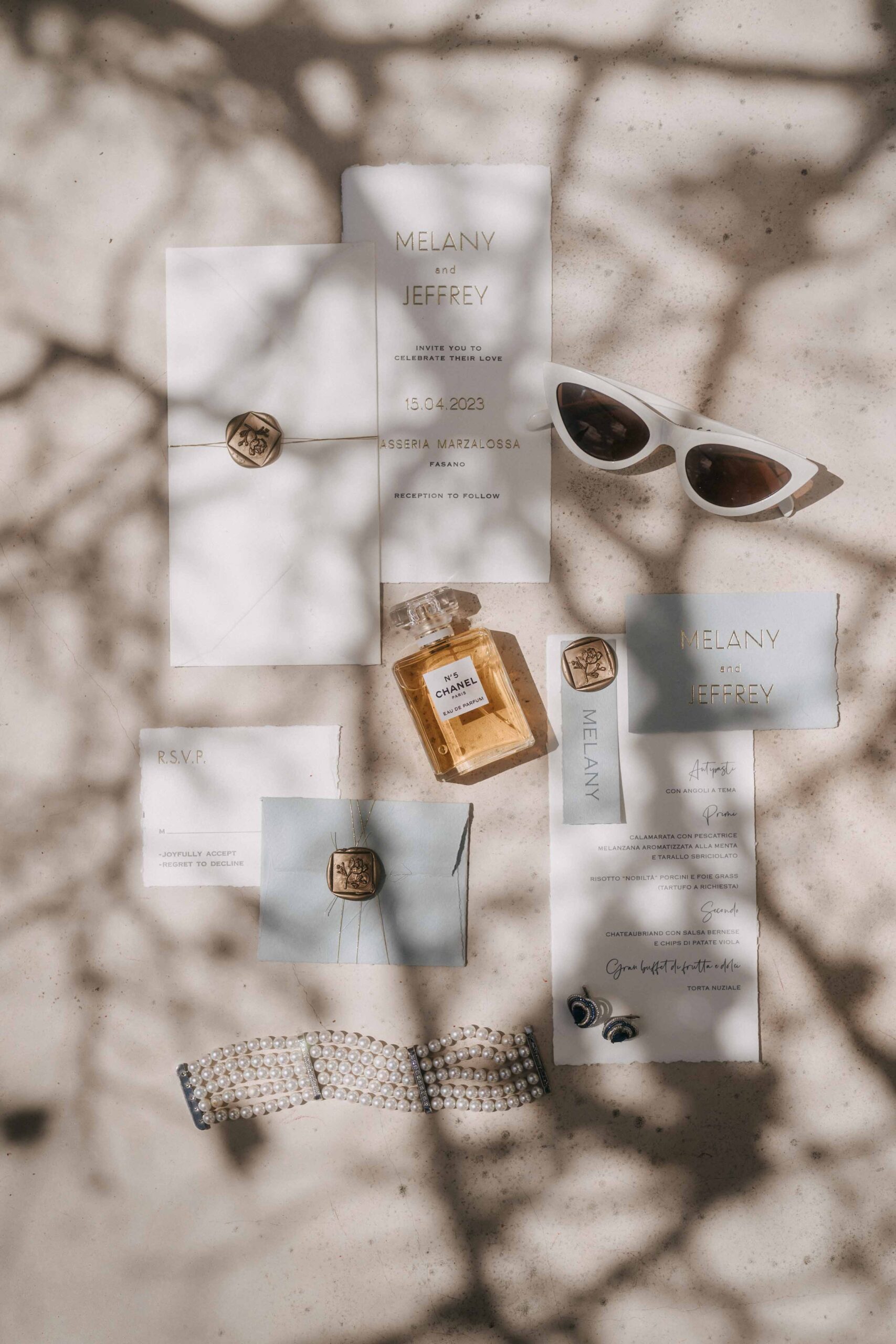
Why white architecture changes the photograph
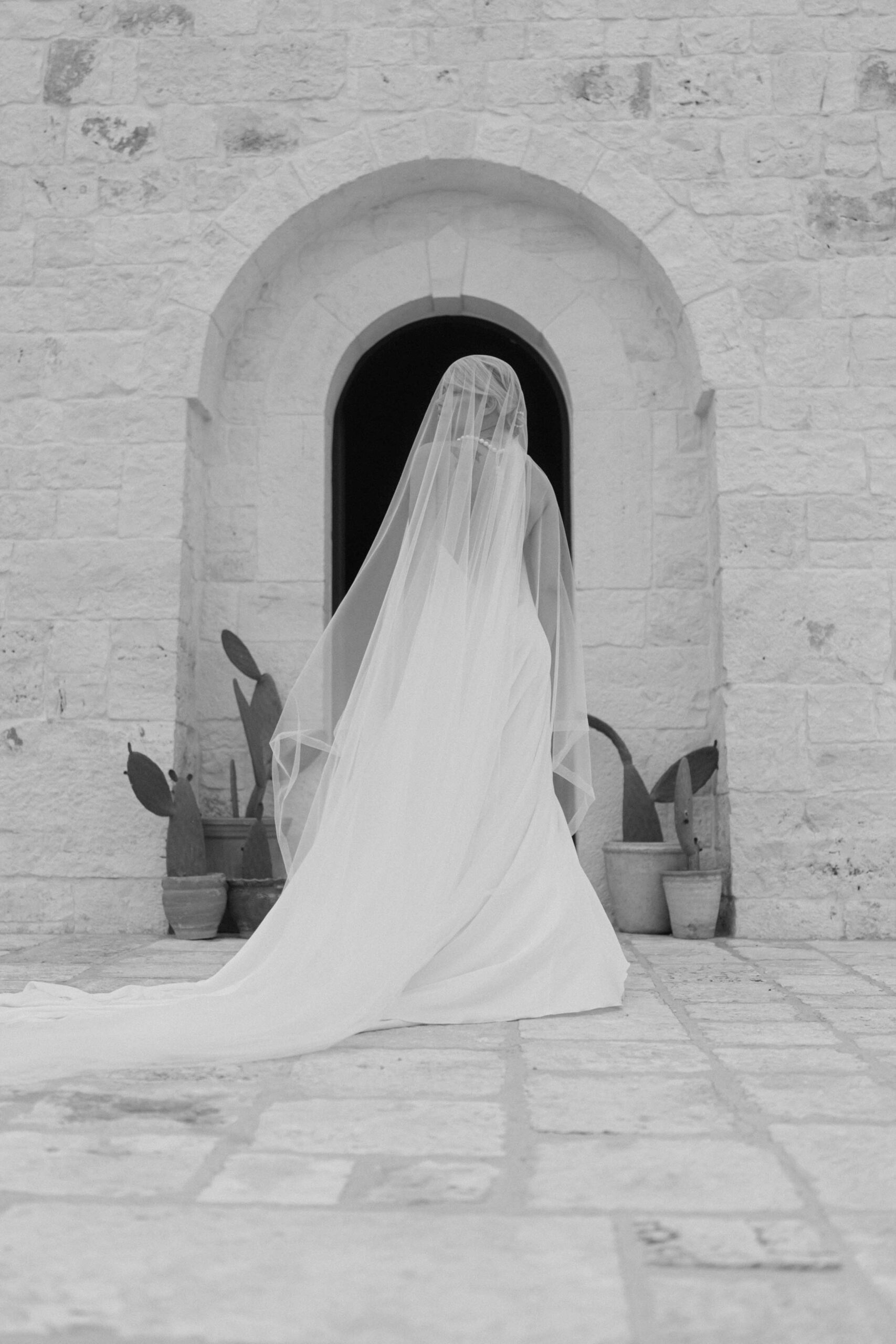
Whitewash is not decoration in the Valle d’Itria; it is climate engineering, centuries of lime applied to reflect summer heat. The photographic side effect is enormous. Every alley becomes a corridor of bounced light: a couple standing in shade is lit softly from three directions, shadows fill themselves, and skin tones sit on a neutral field with almost no color contamination. Conditions that require careful management elsewhere, hard noon sun, deep shade, mixed light, resolve themselves against white walls.
The discipline this demands is tonal. A white town photographed carelessly turns into a high-key blur where the couple floats in nothing. We expose to hold the texture of the lime, the brushwork, the repairs, the gray of worn stone underfoot, because that texture is the difference between a place and a backdrop. It is the same logic Paolo Roversi applies to a plain canvas: the surface must remain a surface, not a void.
The towns, read individually
Ostuni, the Città Bianca, is the most photographed and the most vertical. Its old town climbs a hill in spirals, which gives elevation changes, staircases, and arches that frame without effort, plus long views over the olive plain to the Adriatic. It is also the most visited, and its canonical angles, the panoramic terrace, the arch on Via Cattedrale, appear in thousands of identical wedding images. We use them rarely and early; Ostuni before eight in the morning is a different town, and its side alleys at any hour carry the same white light without the audience.
Locorotondo is the concentrated version: a small circular center, lanes of impeccable whitewash, flowers against the walls, almost no traffic. For a couple’s session of an hour it may be the most efficient town in Puglia. Cisternino is rougher and more lived-in, with laundry, neighbors, and the texture of actual life, which suits couples who want the images to feel inhabited rather than curated. Martina Franca breaks the pattern usefully: its center is white below and baroque above, portals and balconies in carved stone, and it photographs with a formality the other towns do not have.
Alberobello and its trulli stand apart. The district is a UNESCO World Heritage site and visually unrepeatable, and precisely for that reason it has become the region’s most over-photographed location. A couple posed in a trullo doorway is the Puglia cliché. When a couple wants the trulli, we photograph the geometry of the rooftops, the cones in series, rather than restaging the postcard; many masserie also have trulli on their own grounds, where the same architecture comes without the crowd.

How a white town session fits a wedding day
Most couples marrying in the Valle d’Itria celebrate at a masseria in the countryside, and the towns enter the photography as a dedicated session rather than the venue itself. Two patterns work well. The first is a morning-after or day-before session, an hour in Locorotondo or Ostuni at opening light, unhurried, in a second outfit; it produces a chapter of the album that the wedding day itself cannot, and removes time pressure from the celebration. The second is a short detour on the day, between ceremony and dinner, viable only when the town is within fifteen minutes of the venue and the timeline has been built for it.
What we advise against is the tour: three towns in an afternoon, most of it spent in the car, all of it producing the same white wall. One town, chosen for the couple, walked slowly, gives more than three towns collected.

What we do not do here
We do not block alleys, move residents’ belongings, or treat the towns as sets. These are inhabited places, and the images are better for it; a neighbor crossing the background of a frame in Cisternino is documentary truth, not a flaw to retouch. Couples who want a sterilized version of Puglia, emptied and art-directed, are asking for something we deliberately do not make.
Our complete approach to the region, including the masserie where most Valle d’Itria weddings take place, is in the Puglia wedding photographer pillar page.
Frequently asked questions
Which white town is best for wedding photos?
It depends on the couple. Ostuni offers scale, elevation, and views; Locorotondo offers concentration and quiet; Cisternino offers lived-in texture; Martina Franca adds baroque formality. For a single session with limited time, Locorotondo is often the most efficient choice.
Is Ostuni too crowded for a couple’s session?
In peak season, the famous viewpoints are busy from mid morning. Before eight, the old town is nearly empty, and the side alleys stay quiet most of the day. Timing solves what popularity creates.
Should we do the photos in Alberobello with the trulli?
Only with a clear idea. The trullo doorway portrait is the most repeated image in Puglia. We prefer the rooftop geometry of the cones, or trulli on a masseria’s private grounds, where the architecture appears without the crowds.
When is the best light in the white towns?
The first two hours of the day and the last two. White walls keep the alleys luminous even in shade, but low sun adds direction and warmth, and the towns are at their emptiest early.
Can the town session happen on the wedding day itself?
Yes, if the town is within roughly fifteen minutes of the venue and the timeline allows forty-five minutes on location. Otherwise a day-before or morning-after session gives better images with less pressure.
Do we need permits for photography in these towns?
For a couple’s session with handheld equipment in public streets, generally no. Specific monuments, civil ceremonies in municipal spaces, or larger productions can involve local permissions, which we verify case by case during planning.
Are you looking for a
wedding photographer?

Are you looking for a
wedding photographer?
We’d love to hear about your unique vision. We will craft something truly unforgettable together.
