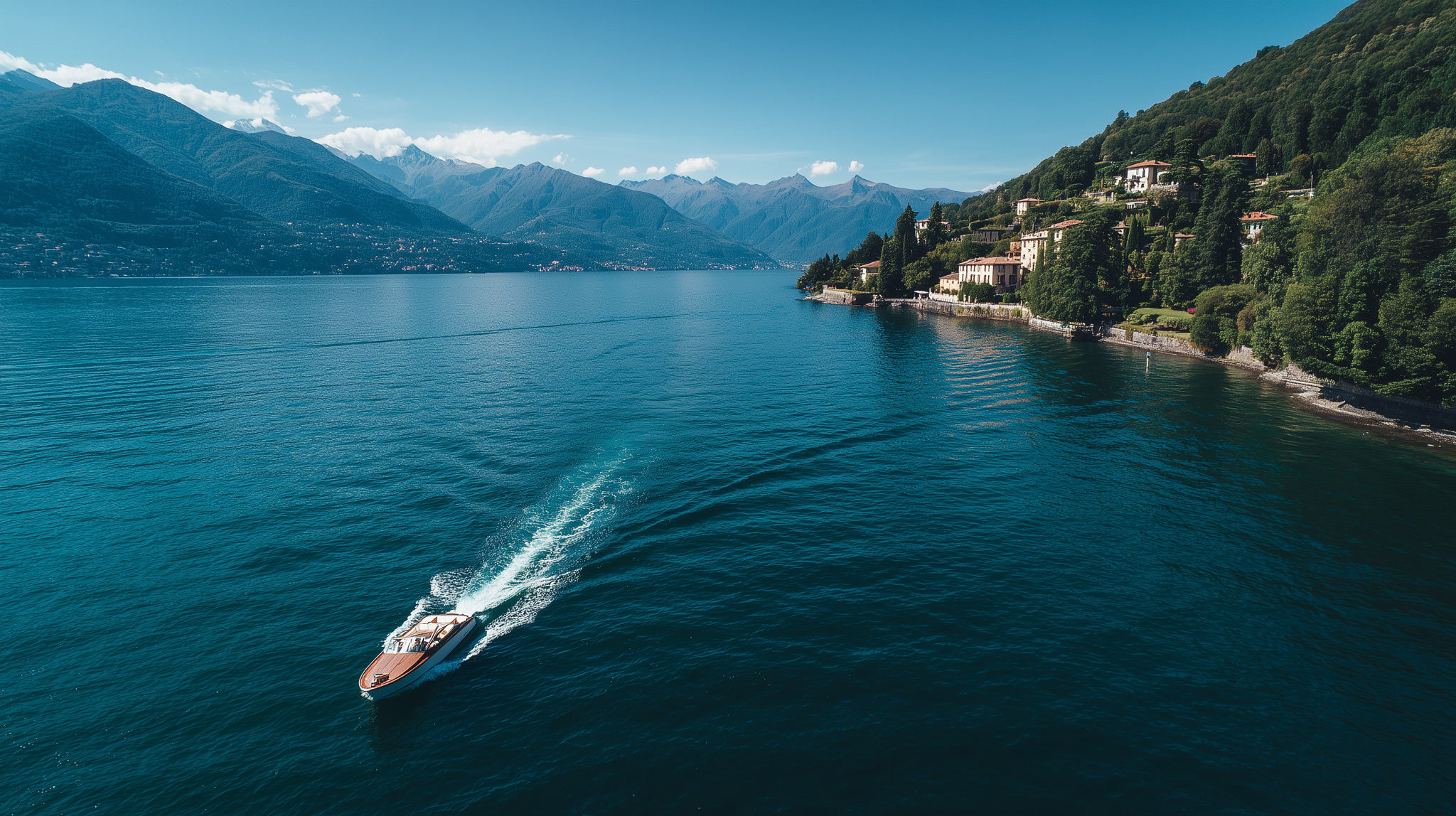
Lake Como is not only a setting. It is a system of movement. A significant share of wedding coverage on the lake involves boat transfers between villas, between guest accommodations and venues, and between ceremony and reception locations. These transfers are treated by most planning documents as logistical events. For photography they are something different: they are the element of the day where the lake itself becomes an active component of the image, rather than a background.
This article collects the studio’s working method for photographing around boat transfers on Como.
Why boats matter photographically
Three properties of a boat transfer make it photographically distinct.
First, the subject is moving through the environment at a speed that is faster than walking but slower than a car. This produces composition opportunities that neither walking portraits nor driving shots can deliver. The couple is still, the world is moving, and the surface of the water is doing unpredictable things.
Second, the light on the lake is different from the light on the shore. Reflection off the water surface adds a bounce light that softens faces. Surface texture, when present, adds visual information below the couple rather than behind them.
Third, the arrival at a venue by boat is a narrative moment. Unlike arriving by car, which is usually obscured and technical, a boat arrival is visible from the venue and builds a clear cinematic opening for the coverage.
The wind pattern
The central variable on Lake Como is the wind. The lake has a reliable daily wind cycle that affects water surface, boat motion, and therefore photographic feasibility.
Before eight in the morning, the surface is usually glassy. Light winds begin around nine or ten. The breva, the southerly wind that rises in the mid-morning, typically reaches peak between eleven and three. The tivano, the northerly wind, is common in the evening.
Between the mid-morning and mid-afternoon wind peaks, open-water portrait sessions are difficult. The boat moves, the hair moves, the water surface is textured, and the compositions become harder to control. The two reliable calm windows are early morning and early evening.
The studio plans boat-based photography around this cycle rather than against it. The seasonal context is covered in weather and light on Lake Como.
Arrival compositions
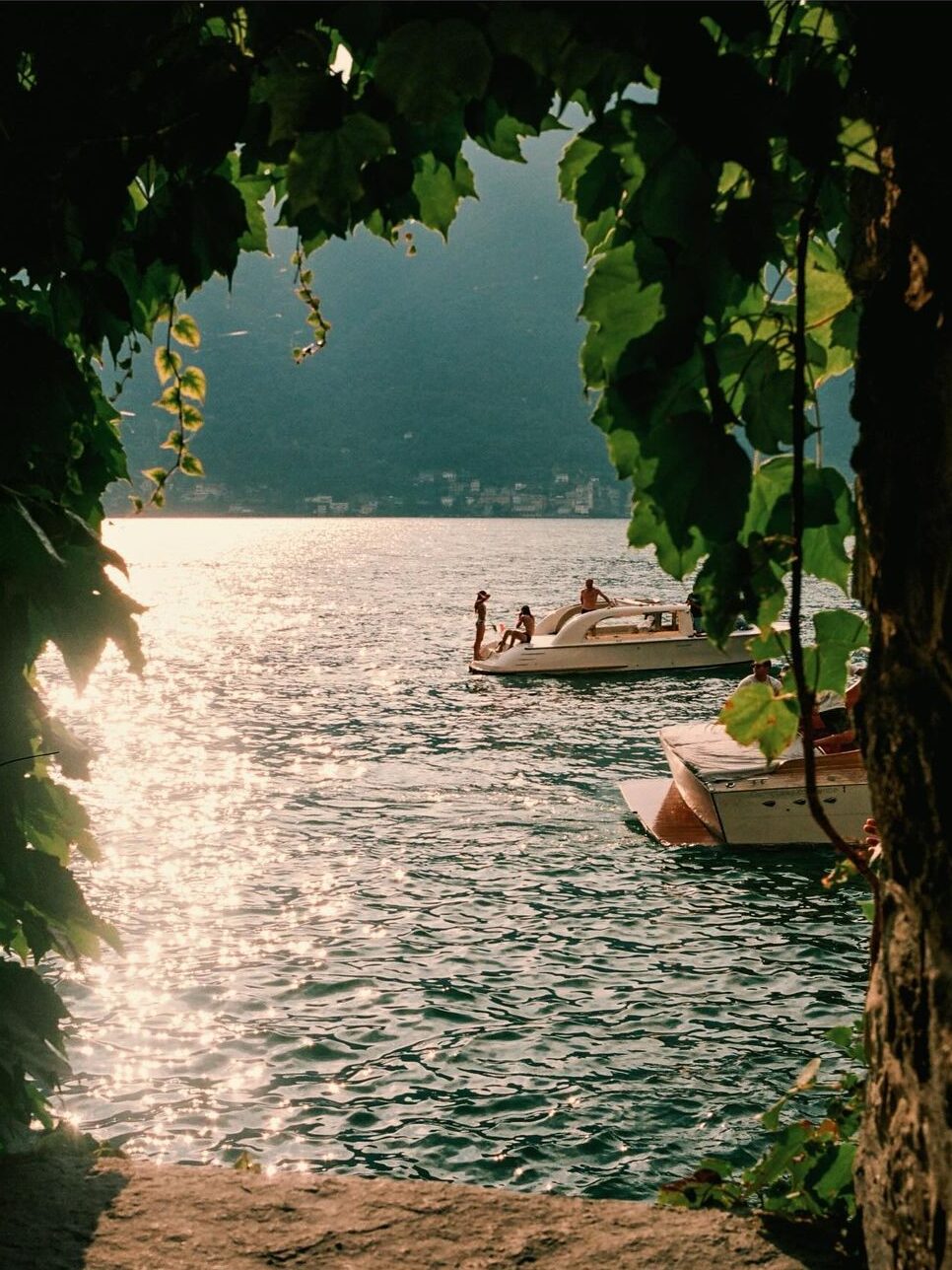
The arrival of the couple at a venue by boat is, in our judgement, one of the strongest photographic moments a Como wedding offers. The composition possibilities include the wide shot from the venue shore, the medium shot from the dock as the boat approaches, and the close shot from the boat itself as the venue appears behind the couple.
Villa del Balbianello is the reference for this. The boat approach along the peninsula gives the couple a view of the loggia from below, while the photographer stationed at the venue shore has a wide shot of the boat approaching the base of the terraced gardens. Villa Pliniana, reached almost exclusively by boat, offers a similar arrival sequence.
These arrivals need to be planned, not improvised. The boat speed, the direction of approach, and the light on the venue facade at the arrival time all need to align.
Transfers between venues
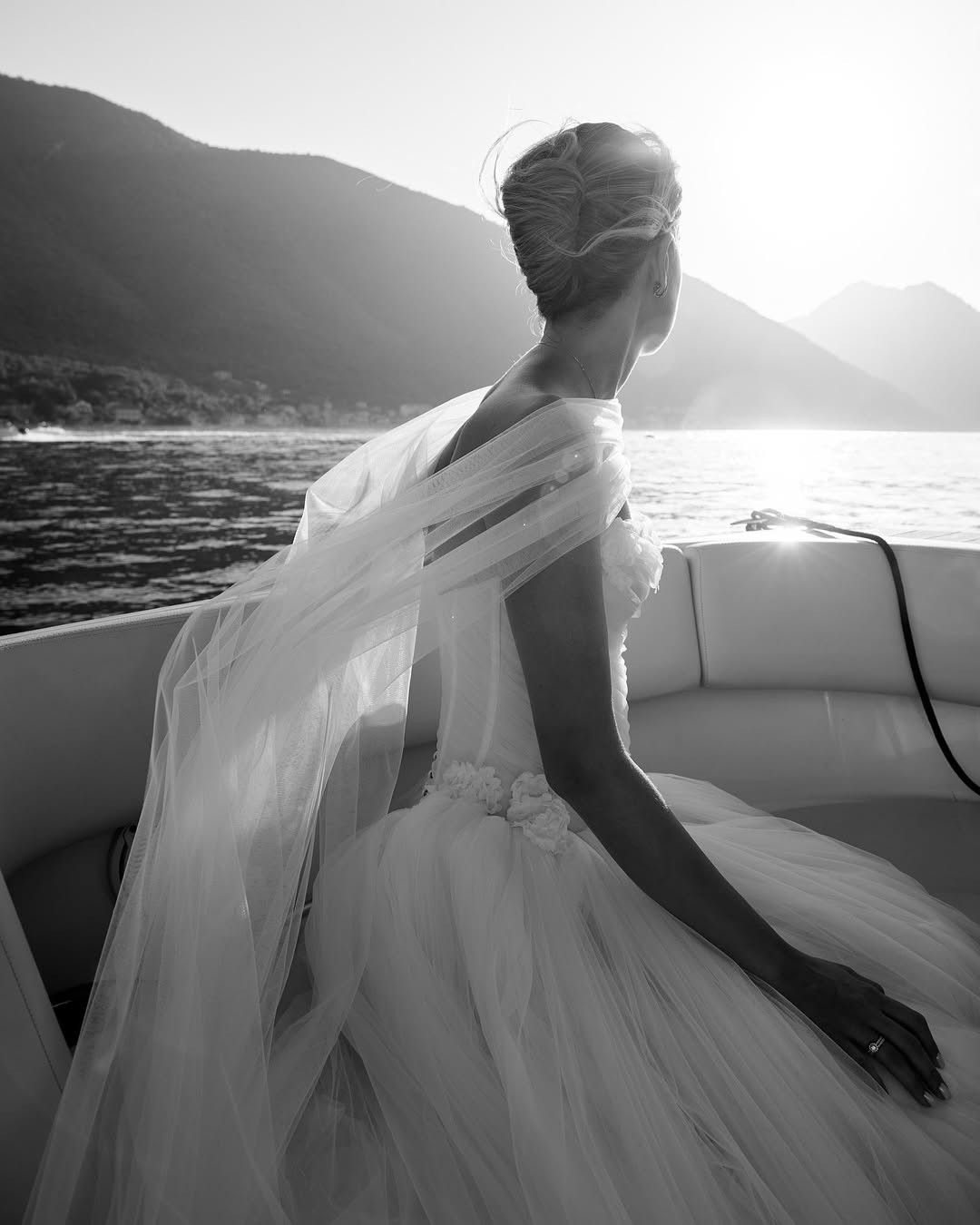
For weddings that involve more than one venue, the boat transfer between them becomes a coverage segment in its own right. Twenty to forty minutes on the water between a ceremony location and a reception location gives the studio a window for couple portraits that combines privacy, a unique vantage on the shoreline, and the specific lake light.
The most common of these routes are from Bellagio across to Villa del Balbianello or Tremezzo, from Moltrasio to Cernobbio, and from Torno to the eastern shore villages. Each route has its own visual character.
Equipment considerations
Working from a boat requires specific equipment discipline. Image stabilization is essential, shutter speeds are kept high, and lens choices favor mid-range focal lengths that tolerate the motion better than either extreme wide or extreme telephoto. The studio brings a dedicated kit for lake work and does not rely on dry-land defaults.
Weather protection is also considered. The lake weather can change quickly, particularly in the spring and autumn shoulder seasons, and equipment protection for water and spray is a standard precaution.
Guest transfers
When guests are transferred by boat in addition to the couple, the coverage design expands. The studio often positions the second photographer at the arrival dock while the lead photographer stays with the couple. This produces two parallel coverages that can be integrated in the final archive: the couple’s intimate experience of the transfer and the collective arrival of the guests.
For larger weddings, multiple boats run sequentially, and the timeline needs to reflect the time required to move the full guest list. The studio works with the planner on these sequences to ensure the photographic windows remain usable.
Safety and pace
Boat transfers are not accelerated by urgency. Safety limits and lake traffic determine the minimum transfer time, and attempting to compress the schedule by rushing the water transitions rarely produces good photographs. The studio advocates for building generous buffer time around boat segments, which protects both the couple’s experience and the photographic coverage.
Limitations
Not every boat transfer produces strong photographs. If the wind is high, the lake is crowded with other boats, the light is hard midday, or the weather is poor, the transfer becomes purely logistical and the photographic coverage shifts to arrival and departure rather than the open-water segment.
The studio makes this call in real time and does not force a portrait session in conditions that will not serve the final archive.
Frequently asked questions
Can you photograph the couple on the boat during the transfer?
Yes, when the wind and light allow. Early morning and early evening transfers are usually workable. Midday transfers are more difficult.
Do we need to hire a photographer’s boat separately?
Usually no. The photographer rides on the same boat as the couple or the wedding party. For larger events, a second small boat for the photographer is sometimes useful to capture wide shots of the main transfer.
How long should we plan for a boat transfer on Lake Como?
Between fifteen and forty-five minutes depending on the route. The studio recommends adding at least ten minutes of buffer time to the expected transit.
Is Villa del Balbianello accessible by car?
No. The villa is reached only on foot from Lenno or by boat. Boat arrival is the standard approach for weddings.
Does wind often cancel boat sessions?
Rarely fully. More often the schedule adjusts, the session moves to the calmer hour, and the coverage shifts toward arrival and departure compositions rather than open-water portraits.
Can the full wedding happen on a boat?
Small elopements and symbolic ceremonies can be held on boats, though most full weddings use boats for transfer rather than as the ceremony venue.

