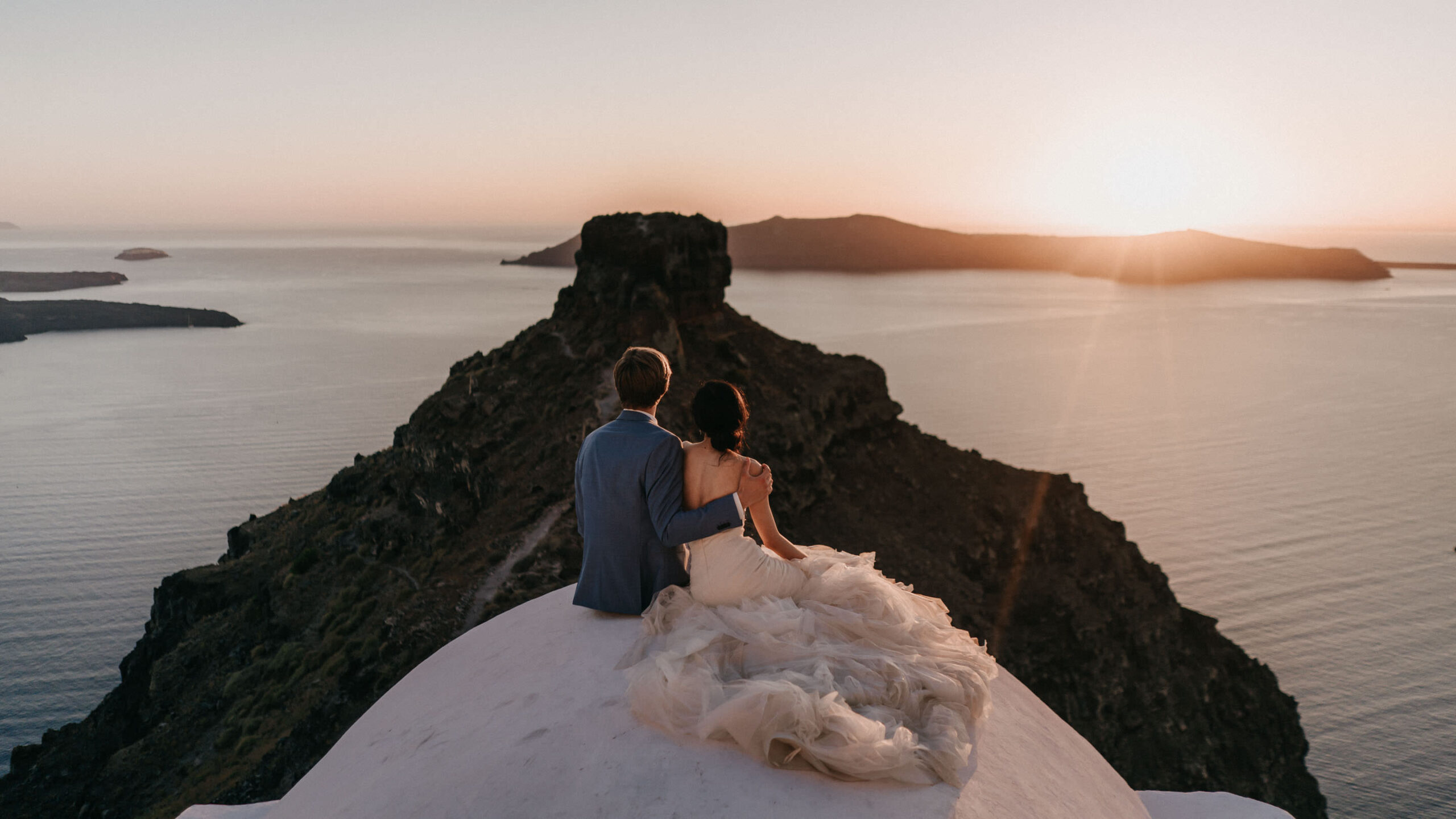
Santorini gives a photographer almost unlimited material. What it does not give is uniform light. The island’s brightness, its reflective white surfaces, and its dramatic caldera geometry mean that the same location reads as five different photographs across a single day. Choosing the best time of day for wedding photos in Santorini is the single most important decision a couple and planner make, together with the photographer, before the wedding date.
This article collects the hour-by-hour logic that Roberto Panciatici Studio applies to every Santorini assignment. For the studio’s complete approach to the island, see the Santorini wedding photographer page.
The first principle: Santorini light is not Mediterranean light
Many photographers arrive on Santorini with habits formed on the Italian coast or the French Riviera. The island punishes those habits. The sun is harder, higher, and more reflective than elsewhere in the Mediterranean. A portrait scheduled for one in the afternoon in Portofino is workable. The same portrait in Oia is not. Treating Santorini light as a stronger version of Mediterranean light, rather than as a different category entirely, leads to predictable results: blown whites, harsh shadows, squinted eyes.
Sunrise, the hour the studio values most
The window from thirty minutes before sunrise to two hours after is the most generous hour of the day for photography on Santorini. Three things happen simultaneously during this window.
First, the caldera faces west, which means the cliff and all the westward facades are in shade at sunrise while the interior island receives the first light. This produces the rare combination of a shaded foreground and a gently illuminated background, which is close to optimal for portrait composition.
Second, the villages are empty. Day visitors have not yet arrived from the cruise ships or the hotels, and most local activity has not started. Oia, Fira, Imerovigli, and the inland villages can all be walked freely.
Third, the light is soft, directional, and color-stable. Skin reads well, whites hold detail, the sea transitions from silver to turquoise over the course of the session.
For couples who accept a hair and makeup call at three-thirty or four in the morning, the sunrise session produces images that simply cannot be obtained at any other time of day.
Mid-morning, from two hours after sunrise
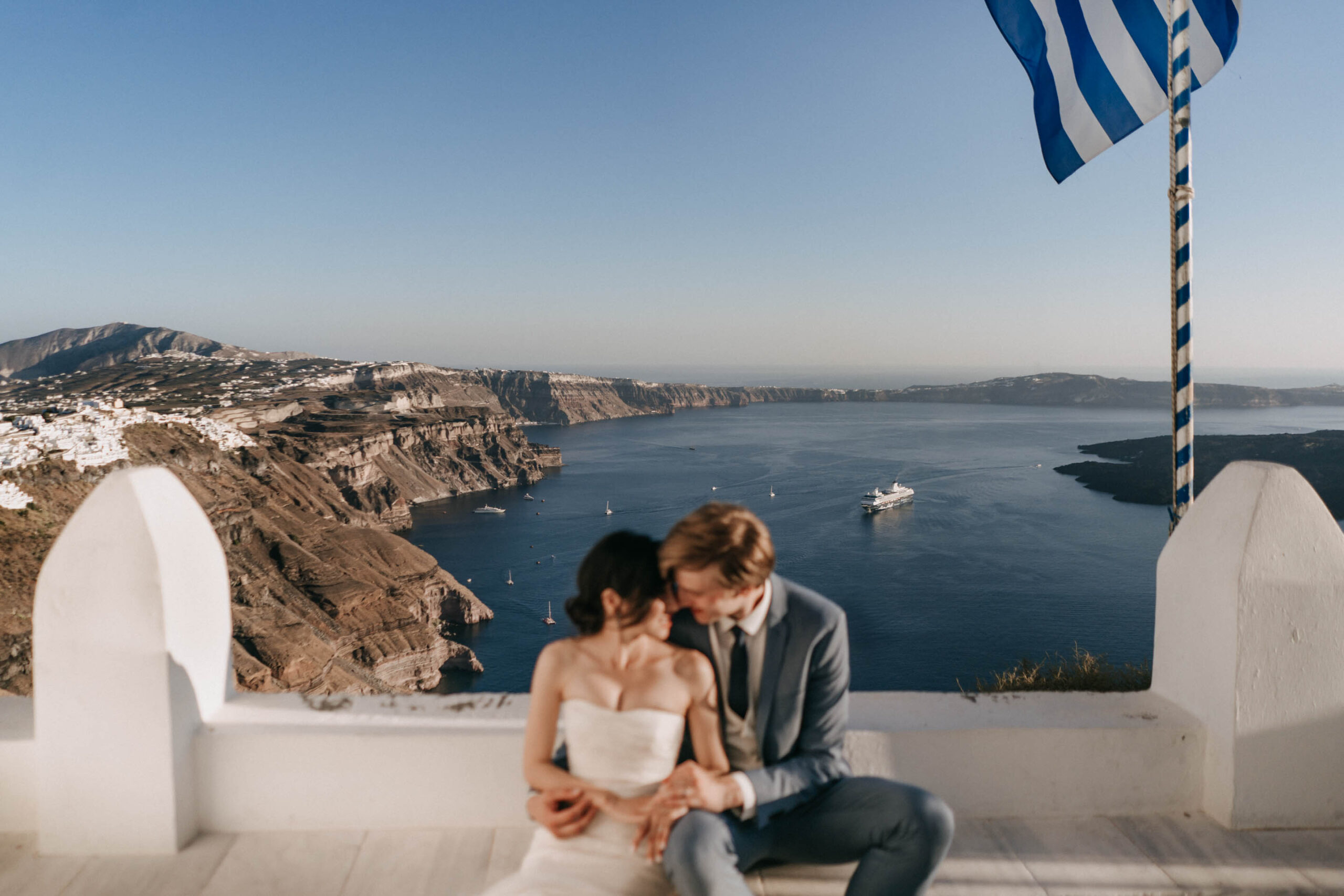
This is a usable window but transitional. The light strengthens, the first visitors arrive, and the heat begins to rise in summer. We use it for secondary locations, for moving through inland villages where crowds are lighter, and for detail work in shaded courtyards.
Midday, from eleven to three
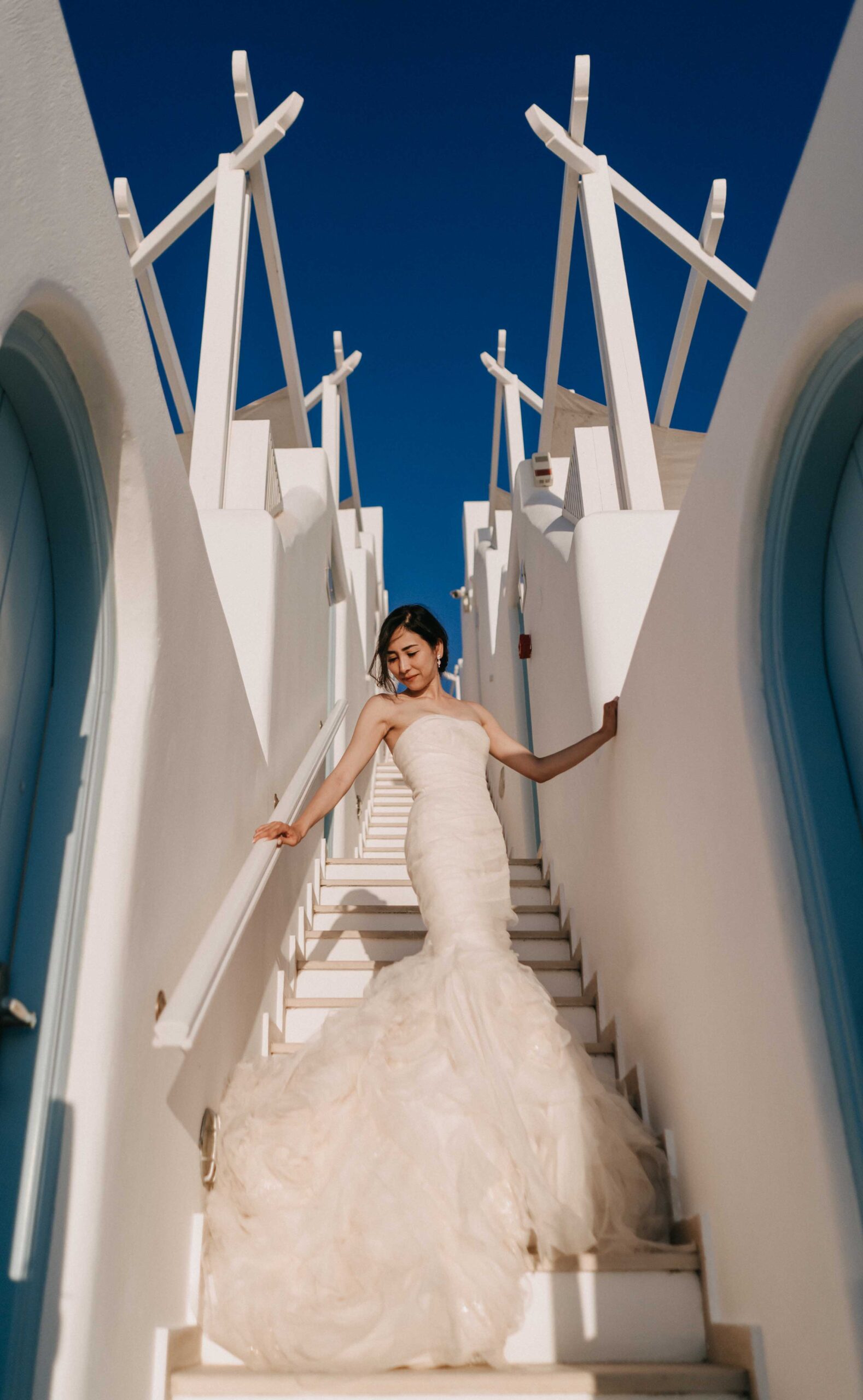
Midday on Santorini, particularly in the high season, is a hard problem. The light is vertical, the whites push past the camera’s ability to hold them, and the faces lose dimension. We rarely schedule portrait work in this window.
When midday coverage is unavoidable, we use three strategies. We move indoors, to a venue’s interior or a pergola. We work in narrow alleys where the buildings themselves provide shade. We switch to detail and documentary work, rings, hands, texture, and reserve the portraits for later in the day.
Midday is also the logistical break in most Santorini weddings. Couples rest, guests swim, the team repositions for the ceremony and golden-hour windows.
Late afternoon, from three hours before sunset
The second primary window opens. The light warms, the caldera faces begin to receive direct sun, and the atmosphere on the cliff villages shifts from exposed to photographic. Portrait sessions, ceremonies timed for late afternoon, and first dances often live in this window.
A precise note: the hour immediately before sunset is strong but not always the strongest. In clear sky conditions, the thirty minutes from ninety minutes to sixty minutes before sunset often produces the most dimensional light, because the sun is still high enough to illuminate facades fully without yet turning into a direct backlight that overwhelms the composition.
Sunset, the overvalued hour
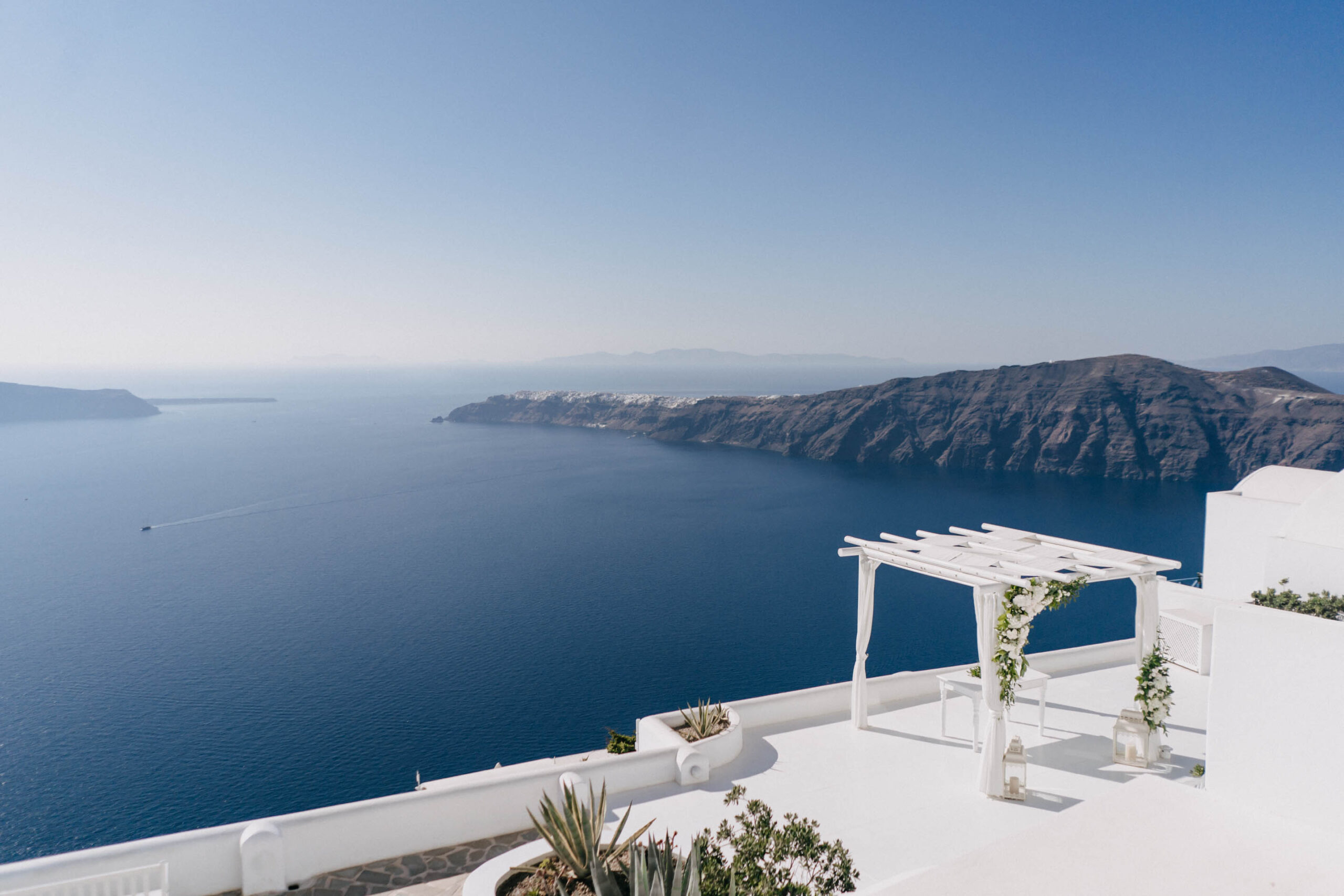
The sunset itself, understood as the five or ten minutes when the sun is at the horizon, is popular but not essential. Santorini sunset photography tends toward silhouette and spectacle, which is a register the studio uses sparingly. We prefer the thirty minutes before and the thirty minutes after.
Blue hour, the editorial bonus
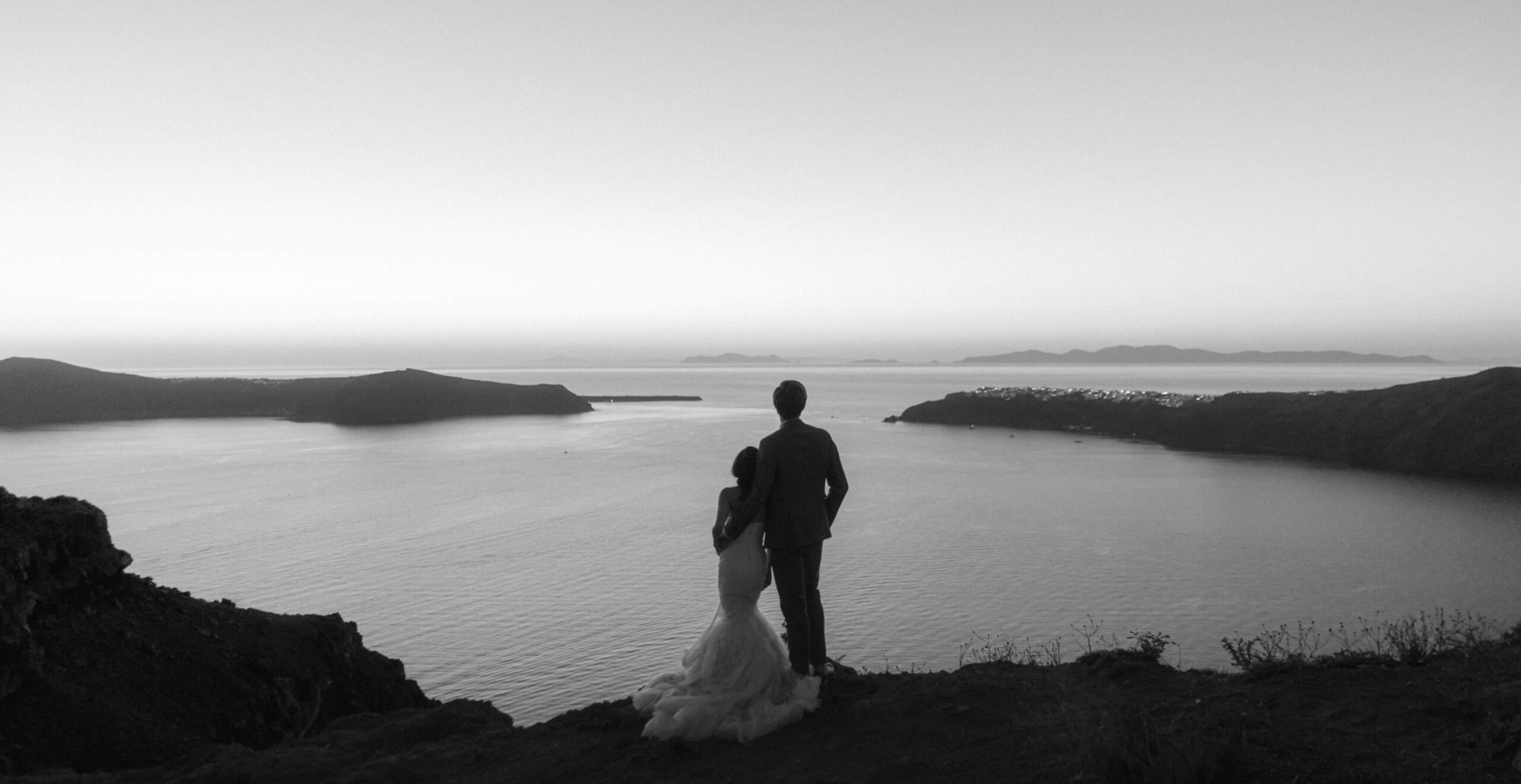
Between ten and forty minutes after sunset, Santorini enters blue hour, which on the island has a specific quality. The sky holds its saturation longer than on the mainland, the village lights come on, and the caldera becomes a geometric silhouette against the water. This is the editorial window, not the wedding coverage window. We use it for a short post-ceremony couple session whenever the schedule allows, typically before dinner begins.
A note on venue-specific timing
Each caldera venue has its own light behavior. A terrace that receives full sun at ten in the morning may be in shade at four. A courtyard that is dark at midday becomes luminous at sunset. The studio walks through each venue in advance, either in person or through detailed floor plans and photographs, and assigns each coverage element to the hour the venue supports best.
A summary timeline for a Santorini wedding
For a caldera wedding in shoulder season, with sunset around eight in the evening, the studio’s recommended timeline looks approximately like this. Exact Santorini sunrise and sunset times shift across the season and are worth checking for the specific date.
Pre-dawn preparation, four-thirty to six.
First couple session at an iconic caldera location, six to seven-thirty.
Breakfast and rest, seven-thirty to ten.
Secondary session, bridal prep, and detail coverage at the venue, ten to twelve.
Midday break and lunch, twelve to three.
Ceremony, late afternoon, around five to six-thirty, depending on the date.
Cocktails and documentary coverage, six-thirty to seven-forty-five.
Short couple session at blue hour, seven-forty-five to eight-fifteen.
Dinner and evening, from eight-fifteen.

Frequently asked questions
Is sunrise really the best hour for Santorini wedding photos?
Sunrise is the most generous hour on Santorini because the caldera is in shade and the villages are empty. Whether it is the right hour for a specific wedding depends on the couple’s schedule and willingness to start early.
Can we skip sunrise and still get good photos?
Yes. Late afternoon through sunset and blue hour produce strong images. The studio recommends including at least one of these windows in every Santorini timeline.
How does midday affect a Santorini shoot?
Midday light on Santorini is hard and unforgiving. Portraits are difficult in direct sun. The studio works indoors or in shaded alleys during this window, and focuses on detail and documentary coverage.
Is sunset the best time for caldera photos?
The thirty minutes before and after sunset are stronger than the sunset itself, in most conditions. The studio composes for the wider window rather than the instant of the sunset.
Does the time of year change these recommendations?
The hours shift with the season. In midsummer the good windows open earlier and close later. In shoulder season the usable hours compress. The underlying principles remain the same.
How long does a Santorini couple session usually take?
Forty-five to ninety minutes for the primary window, with a shorter twenty to thirty minute session at blue hour when the schedule allows.
If you are planning a Santorini wedding and want the timeline designed around the light, reserve a conversation with the studio.
Are you looking for a
wedding photographer?

Are you looking for a
wedding photographer?
We’d love to hear about your unique vision. We will craft something truly unforgettable together.
