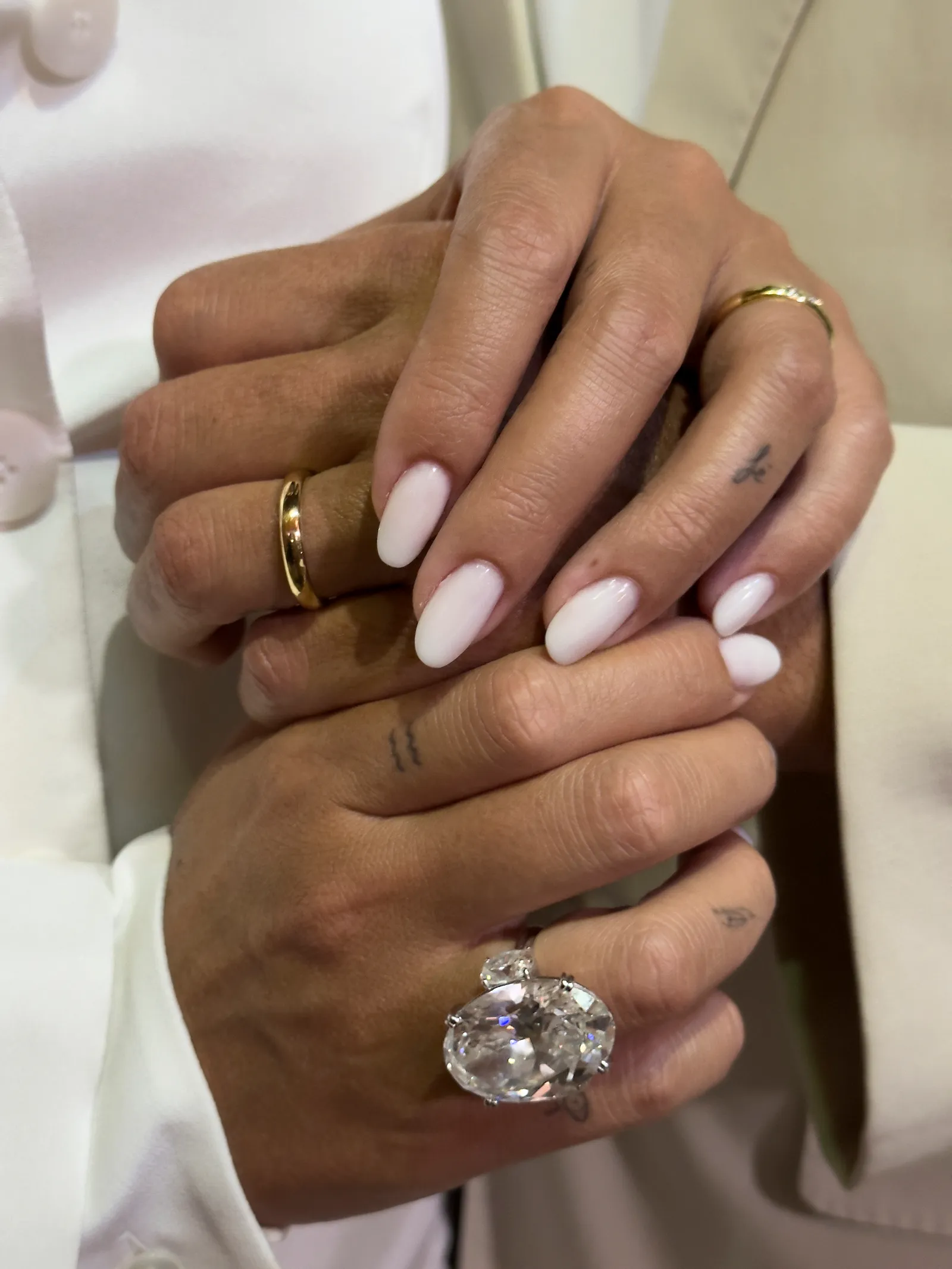
On 11 August 2026, Cristiano Ronaldo, the most followed person on the planet, got married inside his own house, in front of his five children and four witnesses, wearing a beige cotton suit and loafers. There was no cathedral, no guest list, no drone footage. The announcement was a single photograph of two hands and two rings, captioned “C, heart, G”. The Cristiano Ronaldo wedding photos followed five days later, in Vogue, shot by Juergen Teller.
For anyone who works in weddings, this is the most instructive story of the year. Most of the coverage has read it as gossip. It is not gossip. It is a very clear statement about where luxury is going, made by someone with no commercial reason to make it quietly.
What actually happened in Cascais
Cristiano Ronaldo and Georgina Rodríguez married in a civil ceremony at 1:30 in the afternoon at their home in Quinta da Marinha, in Cascais, near Lisbon. Their five children were present, along with four witnesses. Nobody else.
The date was not incidental. Rodríguez had announced their engagement publicly on 11 August 2025, exactly one year earlier.
Spanish outlet Infobae reported that the couple chose to hold the ceremony in the room where the family eats every day, with the intention that the children would go on using that room and remembering what happened there. Whether or not that is the whole story, it is a remarkable piece of thinking. It treats the ceremony as something that has to keep living inside an ordinary space, rather than something staged in a space borrowed for the occasion.
Neither of them made a statement beyond a short press confirmation and the photograph of the rings.
The cathedral that was not the cathedral
The counterexample happened three days before, and it is worth understanding because it explains the choice.
Portuguese press had reported for weeks that the wedding would take place at Funchal Cathedral in Madeira, Ronaldo’s home island, followed by a reception at a nearby hotel. On 8 August, according to Euronews, around two thousand people gathered outside the cathedral to watch. A wedding did take place. It belonged to another couple, two private citizens who found themselves in front of a crowd that had come for someone else.
That is what a public wedding costs now. Not the budget. The fact that the event stops belonging to the people getting married and becomes a piece of content that thousands of strangers feel entitled to attend.
Ronaldo and Rodríguez kept the real location secret until the ceremony was already over. Read against the scene in Funchal, the living room in Cascais is not modesty. It is control.
A skirt suit instead of a gown
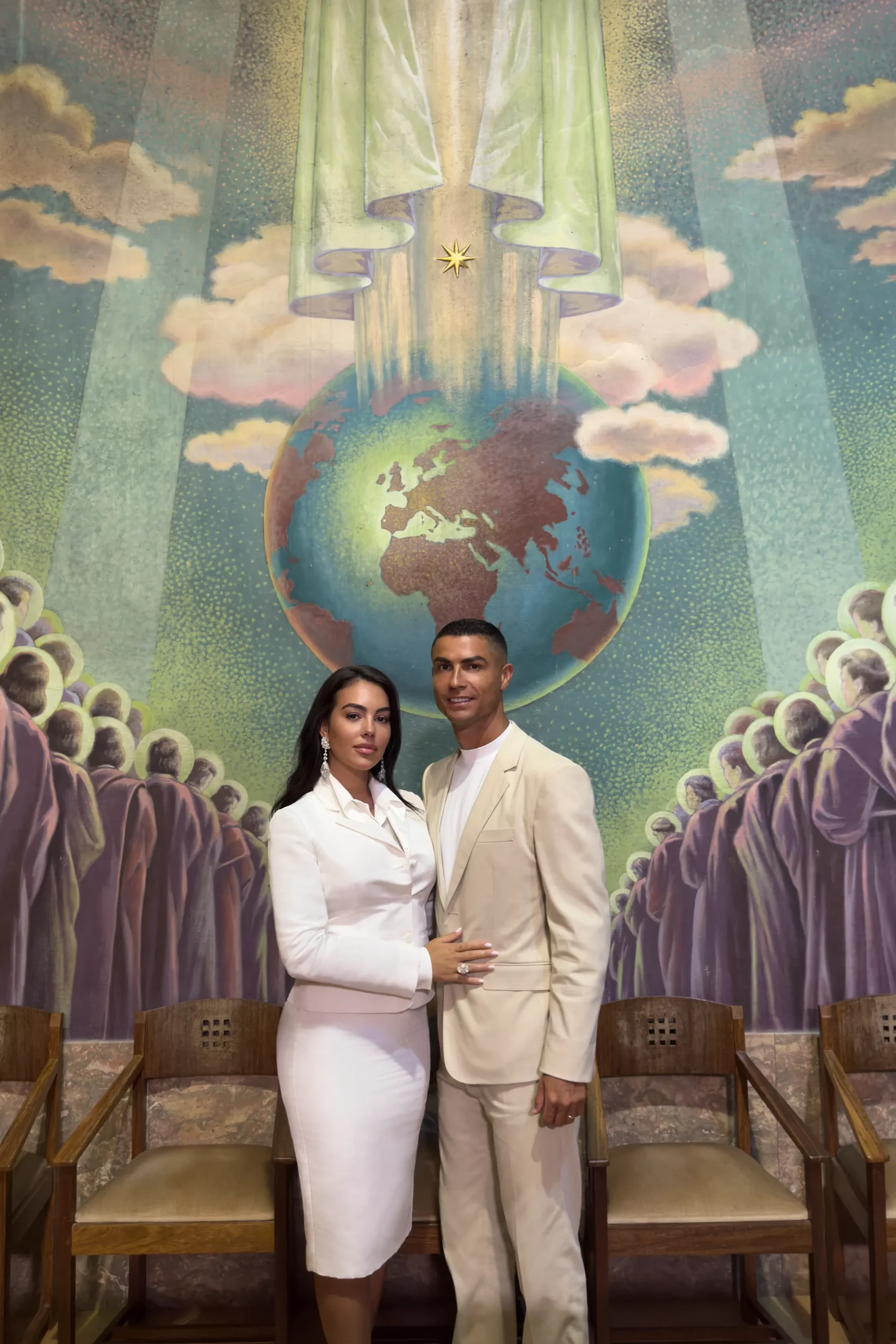
Rodríguez did not wear a wedding dress. She wore a silk faille skirt suit with matching satin shoes, custom Gucci by Demna. Ronaldo wore a custom light beige cotton suit and loafers. The children were in Gucci too.
The house was not a neutral choice either. The couple met while Rodríguez was working at a Gucci store in Madrid. The clothes are a reference to how the relationship started, legible to the two people who lived it and to almost nobody else. That is a very precise way to use fashion at a wedding, and it is the opposite of how fashion is usually used at weddings, which is to be seen.
There is a practical lesson buried here. A skirt suit photographs completely differently from a gown. It has no train to arrange, no volume to manage, no silhouette that demands distance and a wide lens. It puts the subject at conversational range and keeps the attention on posture, hands and face. If you dress for the room instead of the aisle, the pictures change register before the photographer does anything.
Why the Cristiano Ronaldo wedding photos look the way they do
Vogue ran the story as a digital cover and sent Juergen Teller.
This is the part of the story that deserves more attention than it has received. Teller is not a wedding photographer and has never pretended to be one. His register is flat frontal flash, deliberately unflattering framing, humour, and a refusal of the smoothing that celebrity photography normally applies. He has spent thirty years photographing famous people in ways that make them look like people.
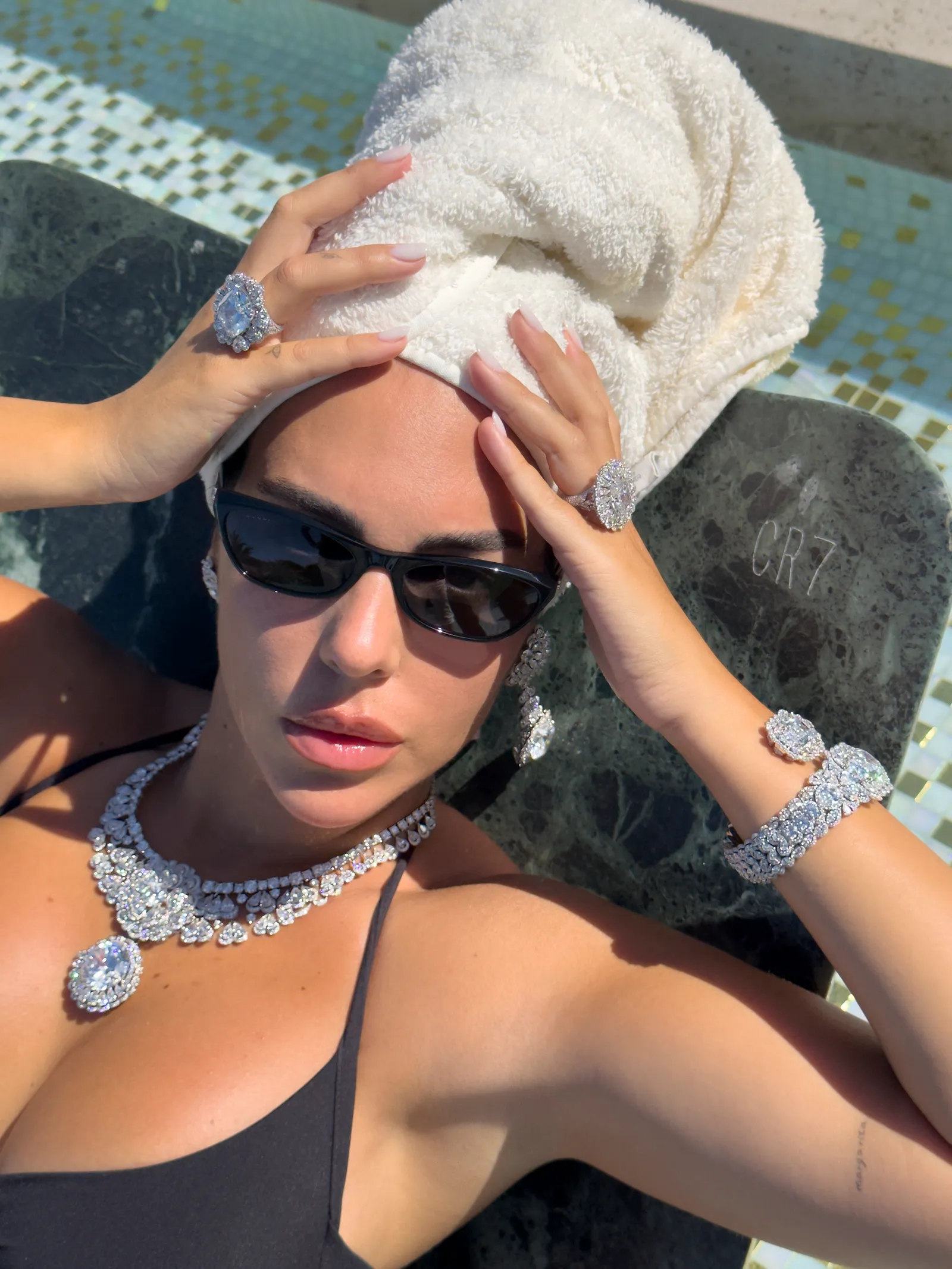
Sending him to cover the most anticipated wedding of the year is an editorial decision with a thesis in it. The published images include the ceremony, family scenes with the children, Rodríguez wearing Chopard jewellery by the pool and while exercising. They read less like a celebrity wedding portfolio and more like pages from a private album that happened to be made by a very good photographer.
Some of it is awkward. That is not a failure of execution. Teller has always understood that a slightly awkward frame carries more information than a perfect one, because the perfect one has already decided what you should feel.
The reaction, and what it tells you
The response was divided, and loudly so. A recurring complaint was that the images look solemn and glum for a wedding, that the framing is strange, that this is not what a celebration is supposed to look like. Fashion Times collected a number of these reactions, including people asking whether the couple were at a conservative convention.
The disappointment is the interesting part. It tells you exactly what audiences have been trained to expect from wedding imagery: high gloss, symmetrical joy, everyone at their most attractive, nothing unresolved. Teller delivered none of that, and a large number of people experienced its absence as an error rather than as a choice.
We would argue the opposite. The frames that will still be worth looking at in twenty years are almost never the ones that were most immediately pleasing. Polish dates faster than anything else in a photograph, because polish is always the polish of a specific decade. What survives is information: how someone actually stood, what the light in that particular room actually did, who was looking at whom.
What this means if you are planning a wedding now
Our studio works from a system we call Modern Elegance, and its core principle is that images should be built to exist beyond the wedding itself, with editorial, cultural and archival value. The shorter version is that we prefer being remembered to being noticed.
The Cascais wedding is that principle carried out by people with unlimited resources, which makes it a useful test. With any budget available to them, they chose nine people and a room they already knew. The restraint was not a compromise forced by circumstance. It was the actual preference.
Three things follow from that, and they apply at any scale.
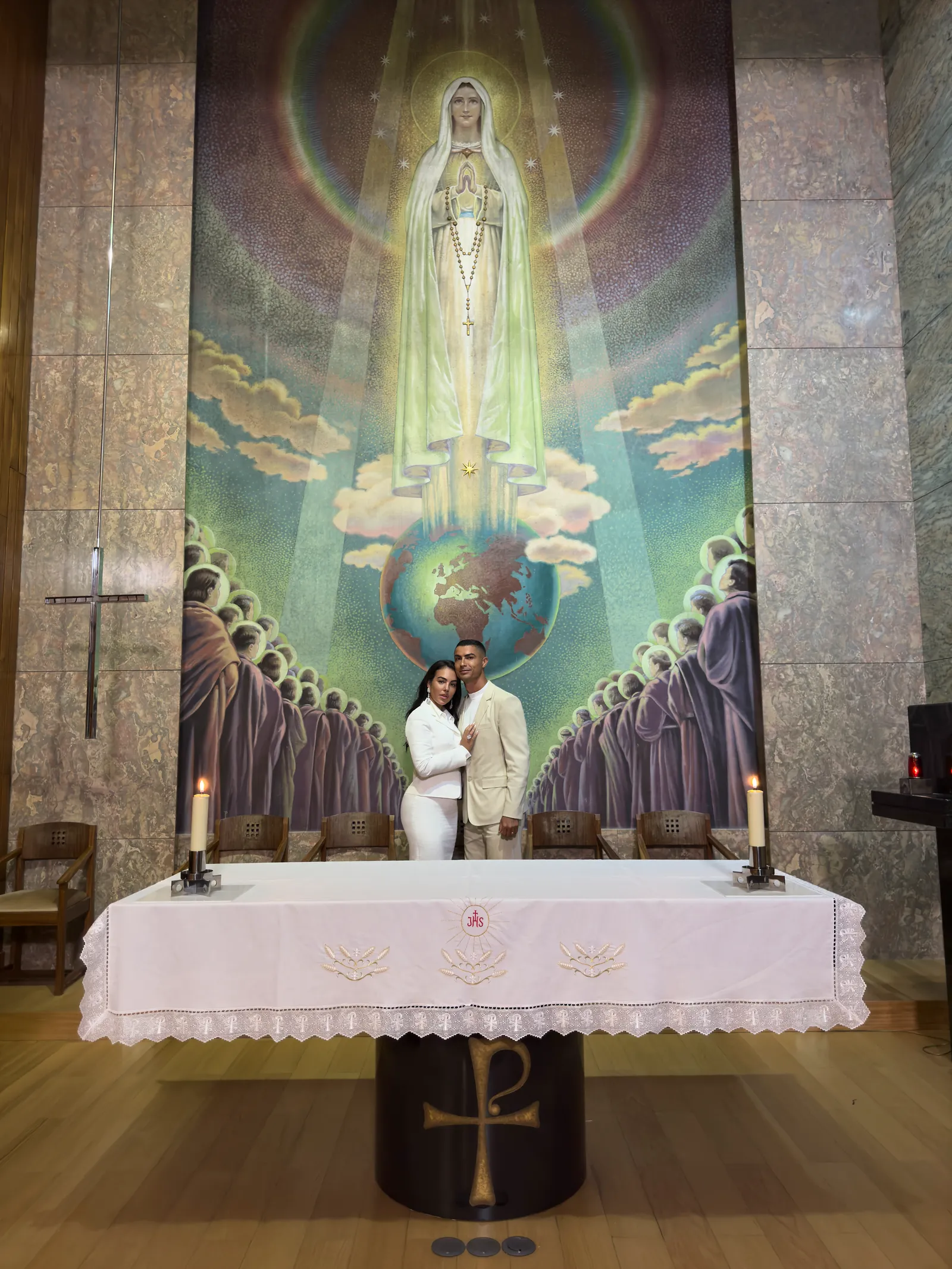
Choose the space for what it means, not for what it will photograph like. A room with history in it gives a photographer something no venue can supply. Scale is not atmosphere, and a beautiful location that means nothing to you will produce beautiful pictures that mean nothing to you.
Dress for the register you want the pictures to have. Clothing sets the distance between the camera and the subject before anyone picks up a camera.
Decide who the pictures are for. If the answer is the guests, or the internet, you will get one kind of wedding. If the answer is the two of you and the people who come after you, you will get another. Both are legitimate. They are not the same commission, and it is worth being honest about which one you are giving.
None of this is an argument for small weddings. Large weddings can be photographed with exactly the same seriousness, and often are. It is an argument for intention. What happened in Cascais was not small by accident.
If you are planning a destination wedding and thinking about how it should be photographed, you can see how we work in the portfolio, or write to the studio directly.
Frequently asked questions
Where did Cristiano Ronaldo and Georgina Rodríguez get married?
At their home in Quinta da Marinha, Cascais, Portugal, on 11 August 2026, in a civil ceremony held at 1:30 in the afternoon. Earlier reports had pointed to Funchal Cathedral in Madeira, but the couple kept the real location private until after the ceremony.
Who was at the wedding?
Their five children and four witnesses. It was a private civil ceremony with no wider guest list.
Who photographed Cristiano Ronaldo’s wedding?
Juergen Teller, for Vogue, which published the images as a digital cover on 16 August 2026.
What did Georgina Rodríguez wear?
A custom Gucci silk faille skirt suit by Demna, with matching satin shoes, rather than a traditional wedding gown. Ronaldo wore a custom light beige cotton suit with loafers, and the children were also dressed in Gucci. The couple met while Rodríguez was working at a Gucci store in Madrid.
Why did they choose such a small wedding?
Neither has explained the decision publicly. What is documented is the contrast with the crowd of roughly two thousand people who gathered outside Funchal Cathedral days earlier expecting to see them, which suggests privacy and control over the event were the priority.

