
A venue on the Amalfi Coast is rarely a single flat space. It is a vertical system: a ceremony terrace at one elevation, a dinner garden at another, suites distributed across several levels, staircases connecting everything. These vertical venues are the defining feature of Amalfi Coast wedding photography, and they require a planning method that is different from the one used for flat country estates in Tuscany or for palace hotels in Paris.
This article is the studio’s working note on how vertical venues reshape the Amalfi wedding day.
The geometry behind the coast
The Costiera Amalfitana is structurally a set of cliffs dropping from the Monti Lattari into the Tyrrhenian Sea. Every town is built on the gradient, with the historic core near the water and the residential zones climbing above. Wedding venues on the coast inherit this geometry. Villa Cimbrone in Ravello organizes its spaces across three major levels. Le Sirenuse in Positano is stacked across multiple floors against the cliff. Il San Pietro di Positano is carved into the rock face over eight levels. The vertical rise between the ceremony location and the dinner location at a typical Amalfi venue is often twenty to sixty meters.
This has four photographic consequences.
Consequence one: timelines lengthen
Vertical movement takes longer than horizontal movement. A guest transition from ceremony to cocktail that would take five minutes on a flat estate takes fifteen to twenty on a cliffside venue, because the movement involves staircases, small elevators with limited capacity, or the slow pace that formal wear imposes on inclined surfaces. The studio builds these vertical transitions into the timeline explicitly, rather than treating them as incidental.
A well-designed Amalfi wedding timeline typically allocates forty to sixty minutes more buffer than an equivalent Tuscan wedding, simply for vertical movement.
Consequence two: coverage splits
On a flat venue, a single photographer can often cover an entire evening by moving laterally around the active space. On a vertical venue, this is rarely possible. The studio’s lead photographer works the highest-value moments at their principal locations while the second photographer or an assistant is positioned at the level above or below to capture parallel activity. For weddings of significant scale, this coordination is planned in writing before the day begins.
Consequence three: staircases become subject
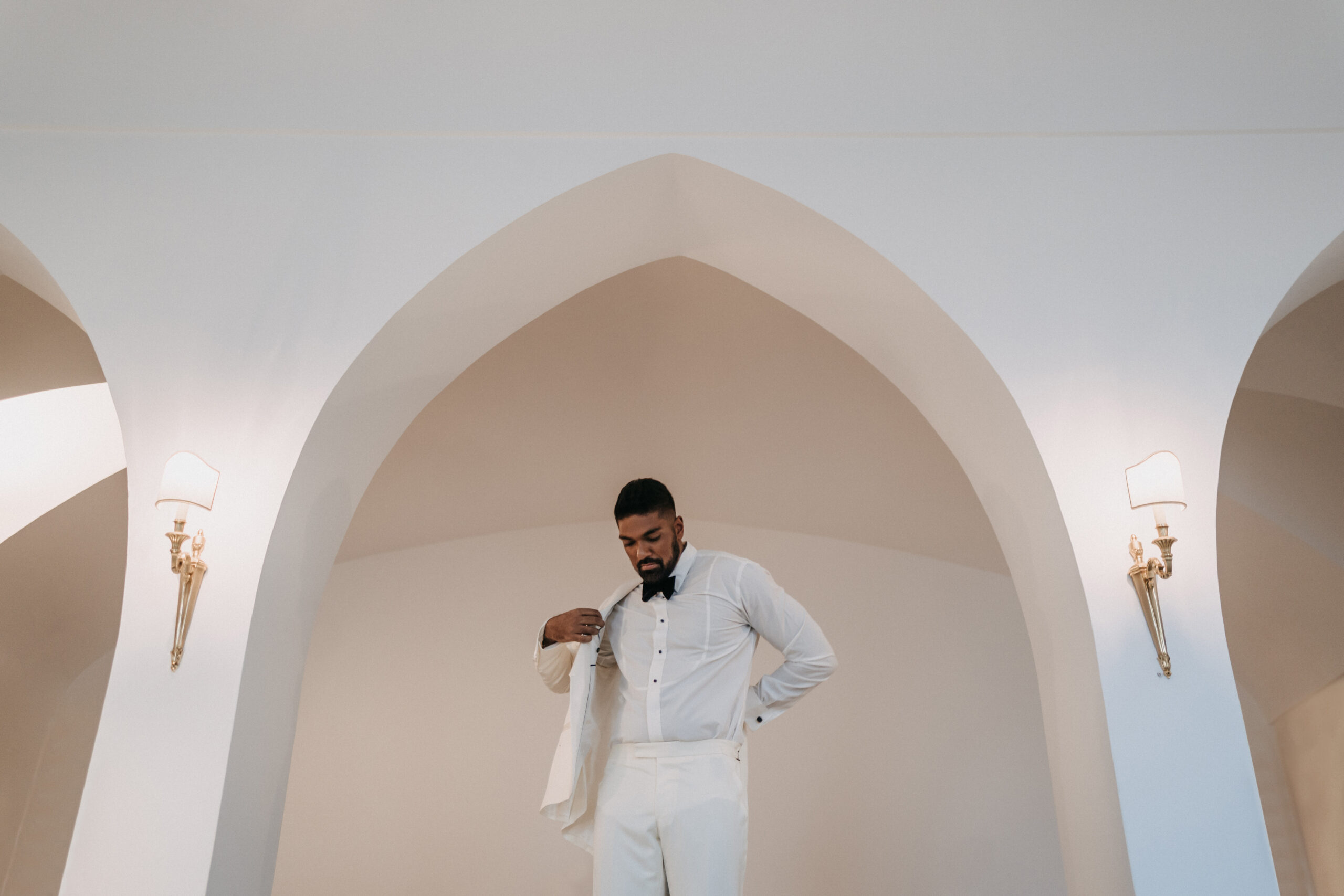
The staircases on the Amalfi are not connective tissue. They are primary photographic subjects. The rise to Villa Cimbrone from the parking, the descent from Villa Treville, the staircase at Villa Treville from the pool terrace to the chapel, the central axis of Il San Pietro, the steps from Piazza Flavio Gioia to Amalfi cathedral: these are among the strongest compositional elements the coast offers.
The discipline is to frame them as architecture, not as traversal. The best Amalfi staircase portraits are still, not kinetic. We often pose the couple at the pivot of a stair rather than walking through it, because the still composition reads as editorial while the kinetic one reads as documentary.

Consequence four: light sections differently
Vertical venues are lit differently on each level. A terrace at sea level receives direct sun while the elevated garden above is in shade, or vice versa. This is a planning opportunity: the studio can move the couple or the session from one level to another based on the light at a given hour. A typical Amalfi portrait sequence might begin on a shaded low terrace at midday, move to a mid-level staircase at three in the afternoon, and conclude on the upper garden at sunset.
Ravello specifically
Ravello is the most elevated of the coastal towns, and its venues are organized accordingly. Villa Cimbrone is the reference. The Terrazza dell’Infinito sits at the villa’s lowest garden level and faces directly onto the coast. Moving upward, the Crypt, the Sala dei Cavalieri, and the main residence rooms each hold their own photographic character. The staircase between the lower gardens and the main villa is the architectural spine of the property.
Villa Rufolo, centered on the gardens that inspired Wagner, operates on a more compact vertical system but with a comparable photographic density.
Positano specifically
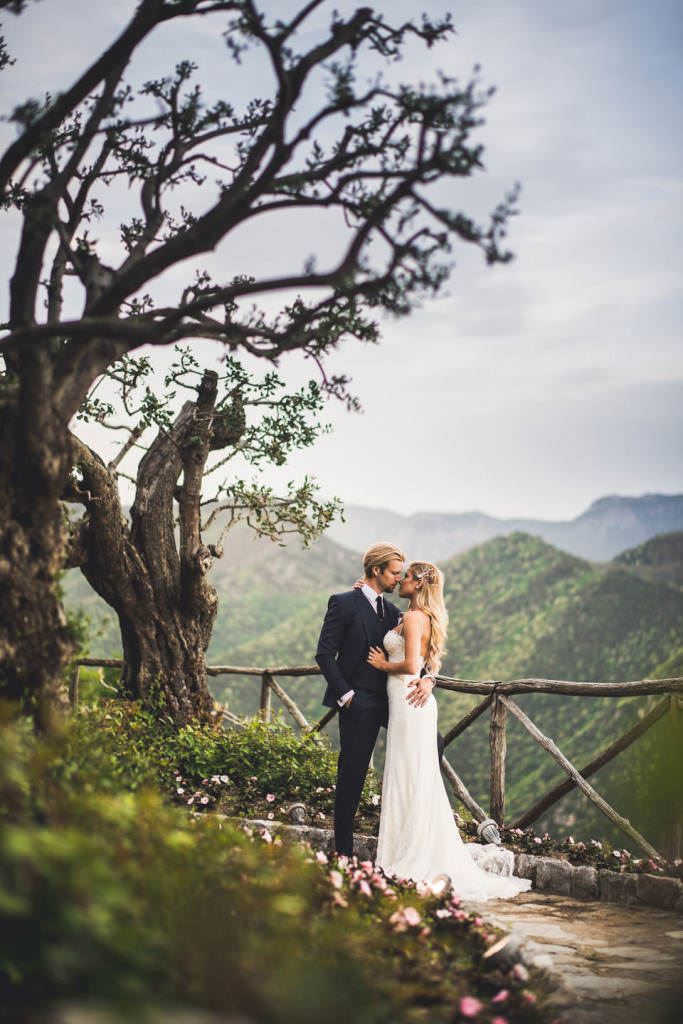
Positano itself is a vertical venue. The town is a system of staircases and alleys rising from the beach to the upper ridge, with hotels distributed across the gradient. Le Sirenuse, Il San Pietro, and Villa Treville each organize their spaces across multiple levels, and the town itself connects them through a network of steps and small lanes.
The studio’s approach in Positano is to plan sessions that move downward through the town rather than upward. Descending is easier for the couple, more photographically varied, and better aligned with the light, which usually improves as the session moves toward the water.
Capri specifically
Capri offers a different vertical system. The town of Capri sits above the Marina Grande, connected by funicular and staircase. Anacapri sits higher still. The luxury hotels concentrated around Via Tragara, the Grand Hotel Quisisana, the Hotel Punta Tragara, and the smaller J.K. Place Capri, organize across multiple levels. Weddings on Capri often include a boat arrival at Marina Grande, a transfer upward to the venue, and a ceremony with the Faraglioni visible from above.
Boat transfers and the sea as entry point
For several venues on the coast, the sea is the primary entry point. Villa Treville, Il San Pietro, and most of Capri are best reached by boat. This changes the opening of the wedding day. The arrival itself becomes a photographic moment, and the composition is horizontal rather than vertical for the first hour. The vertical geometry then resumes as the party moves upward into the venue.
What this means for couples
A couple planning an Amalfi wedding should think of the venue not as a backdrop but as a stack of rooms connected by staircases. Each level holds a different photographic register, and the day should be designed to move between them deliberately. The alternative, a single fixed location for most of the day, underuses what makes the coast unique.
Frequently asked questions
Are Amalfi venues physically demanding for guests?
They can be. Venues with pronounced vertical organization are not ideal for guests with mobility limitations. The studio coordinates with the planner to identify accessible paths where available.
How do staircases affect the bridal outfit?
Significantly. Long trains and unpractical shoes are harder to manage on a vertical venue. Many couples select secondary footwear for the movement portions of the day.
Can we have the entire wedding on one level?
At most venues, no. The structure of Amalfi properties does not support it. Some ceremony-only elopements can be held at a single elevation, but full weddings use multiple levels by design.
How many photographers are needed for a vertical Amalfi venue?
The studio recommends a lead plus one second shooter or assistant for most full weddings. For larger events, a larger team is coordinated in advance.
Does vertical geometry affect the ceremony timing?
Yes. Ceremony timing is planned around the light on the specific level where the ceremony takes place, which is often different from the light on the reception level.
Are there flat venues on the Amalfi?
A few, mostly inland or in the Agerola area above the coast, but they are the exception rather than the rule. Most of the reference wedding venues are vertical.
If you are planning a wedding on the Amalfi Coast, reserve a conversation and the studio will read your venue’s vertical geometry before the timeline is set.

